Deep Wave Research

Research company · Established 2020

Deep Wave Research

Frontier research that survives outside the lab.

The research company I started in 2020 for my independent studies. It began with algorithmic trading and web-3 systems, grew into a run of quantitative-finance work, and has since taken the same evidence discipline out of markets entirely and into signal processing and machine learning.

The firm

Useful structure in evolving systems.

Deep Wave Research explores how new methods, models, and ideas can reveal useful structure in complex, adaptive systems. Markets were the first subject and are still the largest one: difficult to understand precisely because they adapt, and worth studying carefully for the same reason.

The remit is deliberately pointed at where existing approaches run out — at questions where new data, new theory, and new computational tools might explain behaviour older methods miss. Emerging methods get tested against real problems, and what is kept is the evidence that survives outside the lab: clear enough to act on, honest enough to challenge.

Every study stays explicit about what was measured, what was assumed, and what remains uncertain. A result that narrows the field is reported with the same care as one that opens it, because both are how the next question gets chosen.

Edge does not come from complexity alone. It comes from asking better questions, testing them carefully, and knowing when a result is useful, fragile, or incomplete.

The arc

From trading systems to pure signal research.

The subject matter has moved a long way since 2020. The method has not.

  1. 2020

    Founding

    Founded during a stretch of algorithmic-trading and web-3 systems work: strategy prototypes, market-data plumbing, and on-chain infrastructure studies.

  2. 2022 – 2026

    Market studies

    A run of standalone quantitative-finance investigations — microstructure, event studies, risk signals, cross-sectional factors, and model governance — each self-contained, with its methods and limits reported alongside its findings.

    Selected Topics in Quant Finance
  3. 2025 – 2026

    Distributional forecasting

    A staged programme asking where a volatile market carries learnable signal at all, then staging a foundation-model comparison on the answer instead of on intuition.

    Regime-Adaptive Probabilistic Forecasting
  4. 2026

    Departure from markets

    The same wavelet representations, pre-registered gates, and evidence tiers, pointed at tropical-Pacific sea-surface temperature instead of a price series — the move out of quant finance and into pure signal-processing and deep-learning research.

    Wavelet-Domain ENSO Forecasting

The work

Three programmes, one standard of evidence.

Each is a hub of its own. Every card below opens the full series or collection, and every report inside carries the same attribution.

2026

Wavelet-Domain ENSO Forecasting

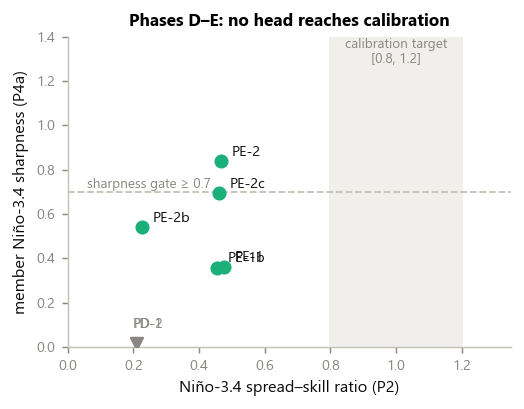
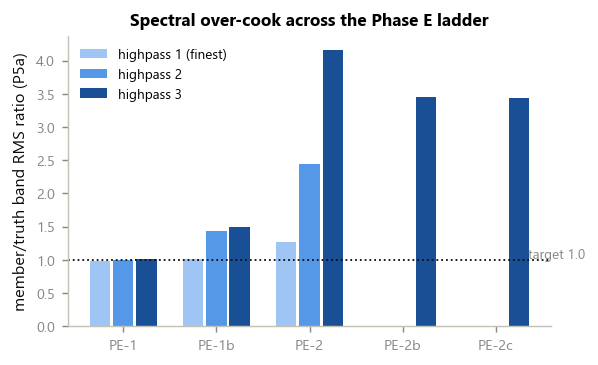
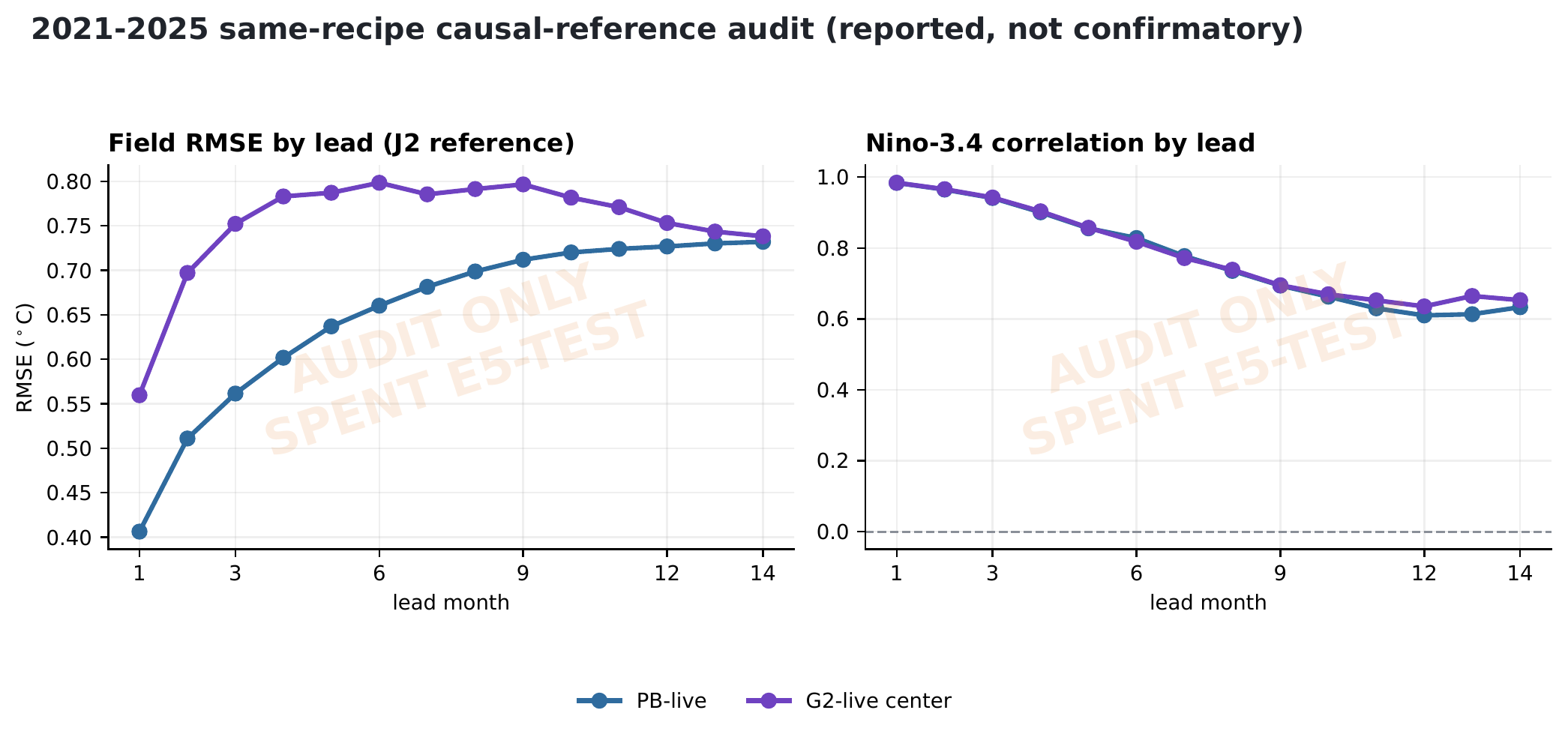
Eleven linked documents on forecasting tropical-Pacific sea-surface temperature inside an exactly invertible complex-wavelet space: a standalone publication, a measurement charter, and nine reports running from system validation to a live-deployment handoff.

Methods
Dual-tree complex wavelets, Earthformer cuboid attention, CMIP6 forecast pretraining, sequence diffusion, EMOS and ECC-Q calibration, hash-gated sealed testing, moving-block bootstrap governance
Outcome
Threads a whole research programme together with its evidence tiers intact: one pristine sealed-test win, two controlled studies that narrowed the design space, a probabilistic stack whose validation advantage only partly transferred, and a deployment contract handed to a prospective live test.
  • Climate Forecasting
  • Wavelets
  • Diffusion Models
2026

Regime-Adaptive Probabilistic Forecasting

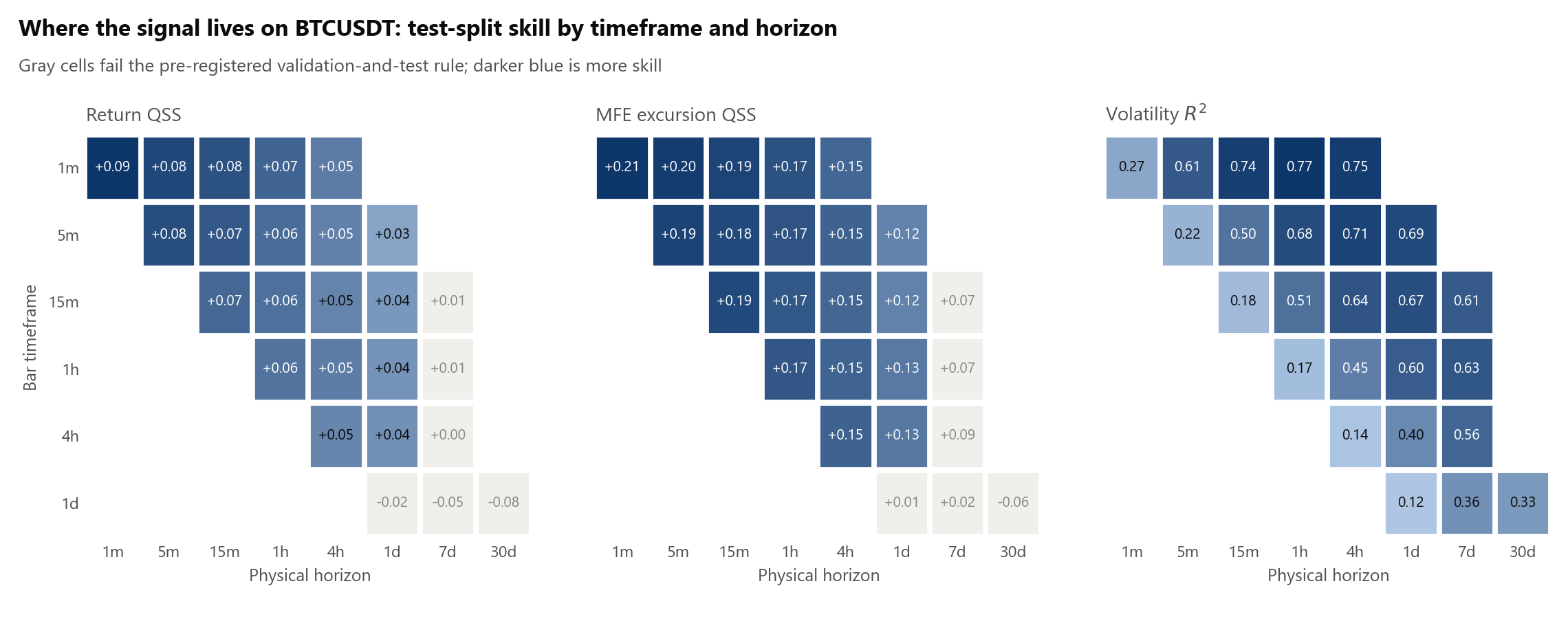
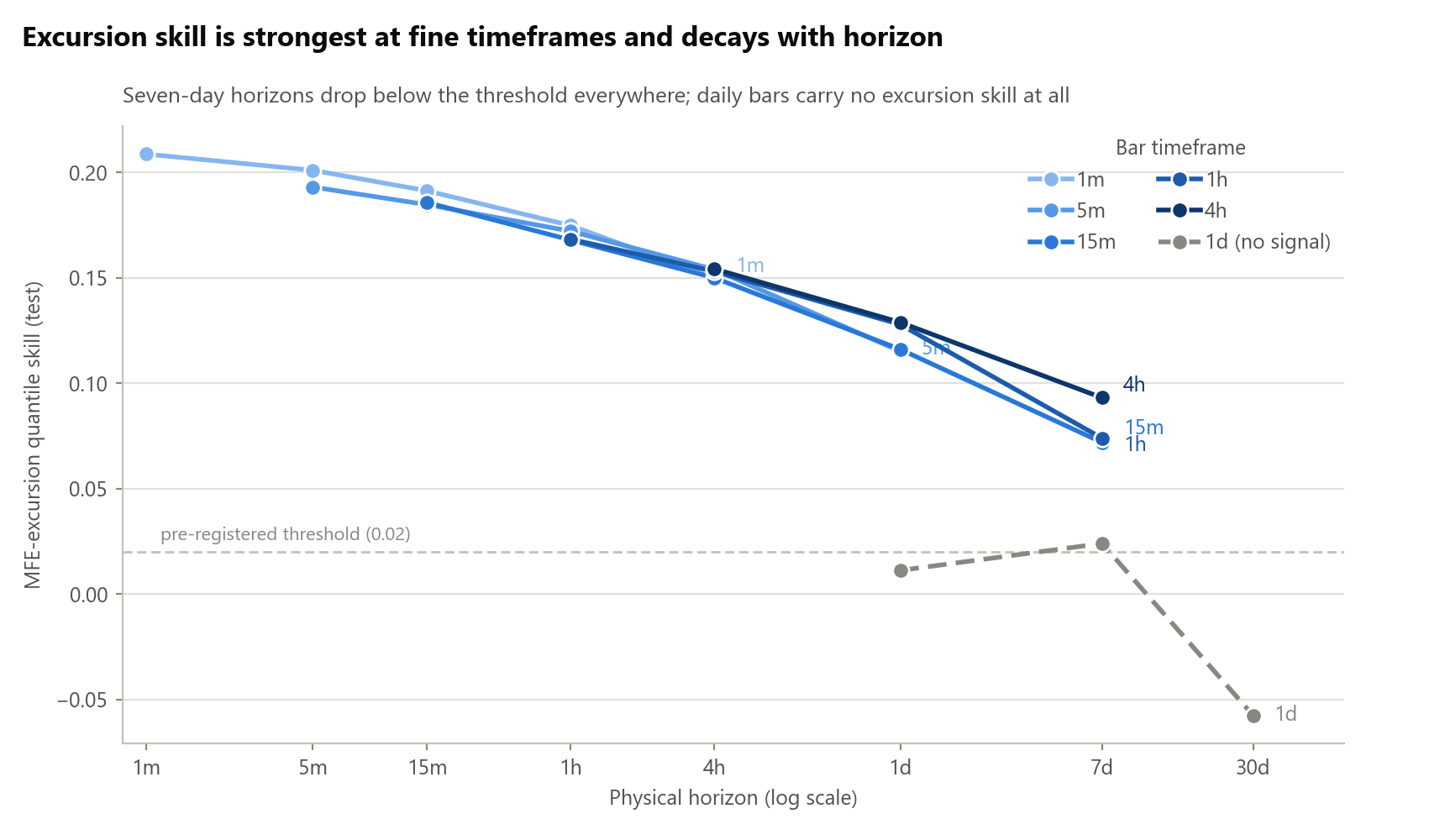
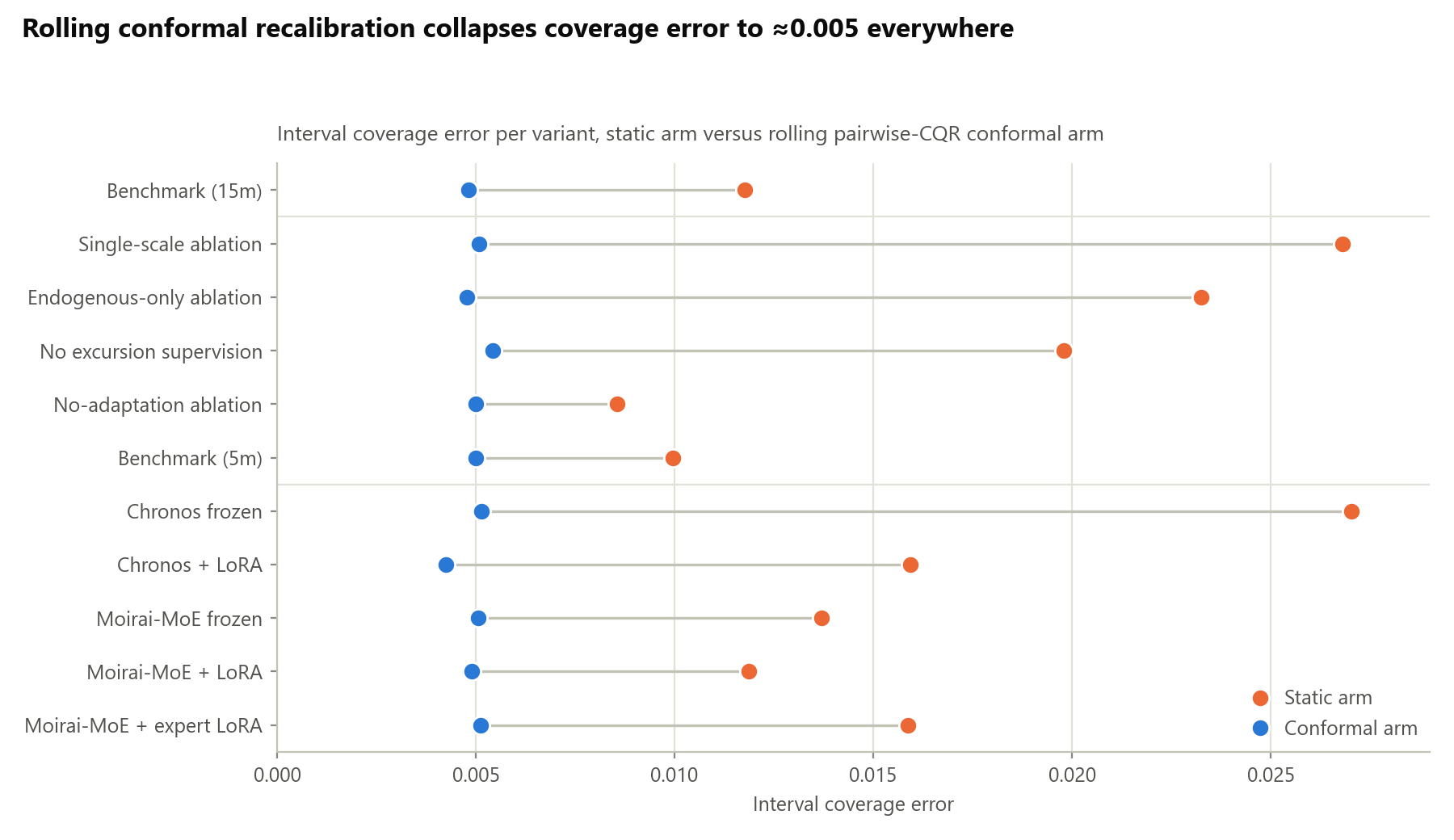
A staged research programme on distributional forecasting of BTCUSDT perpetual futures: groundwork on frozen foundation-model embeddings, a pre-registered scan of where the series carries learnable signal, and a completed walk-forward comparison of from-scratch and foundation-model forecasters staged on those verdicts.

Methods
PyTorch, return and excursion quantile supervision, Chronos-T5 and Moirai-MoE backbones, LoRA fine-tuning, conformalized quantile regression, pre-registered verdict thresholds, purged walk-forward evaluation
Outcome
Establishes that the usable signal is distributional rather than directional, maps where it lives across timeframes and horizons, and shows a small from-scratch encoder is the quality-versus-cost frontier over foundation-model lanes — with fine-tuning helping exactly where a frozen representation is deficient.
  • Probabilistic Forecasting
  • Foundation Models
  • PyTorch
2026

Selected Topics in Quant Finance

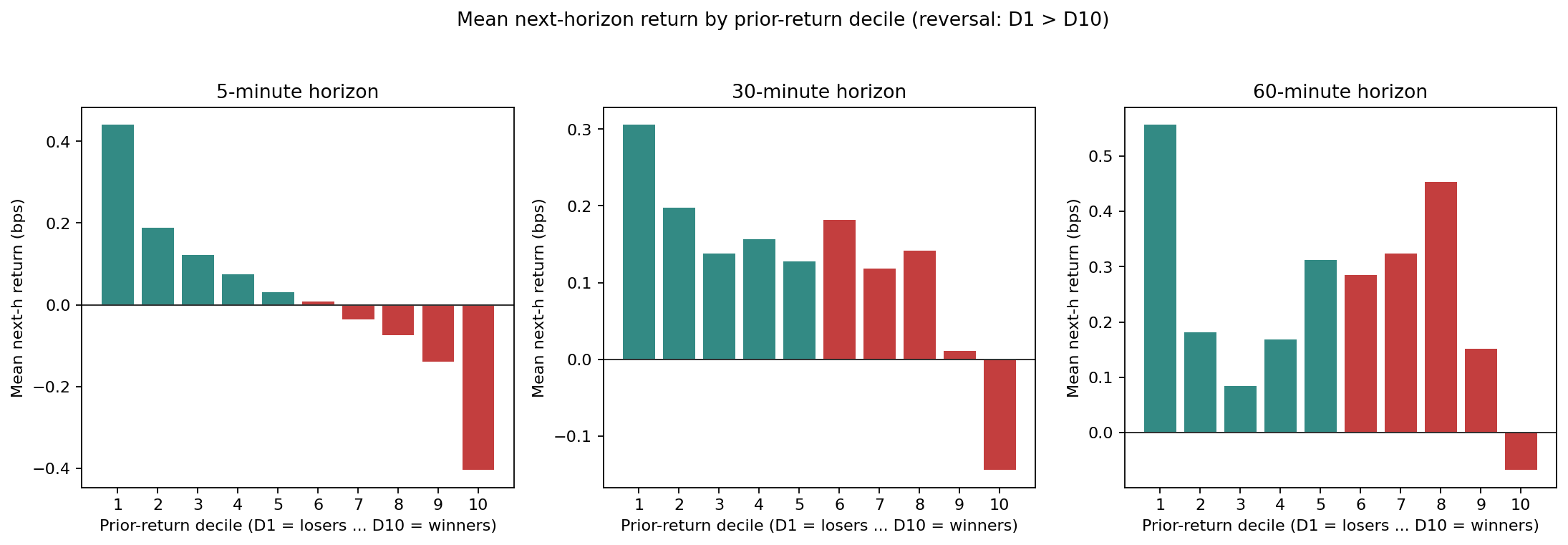
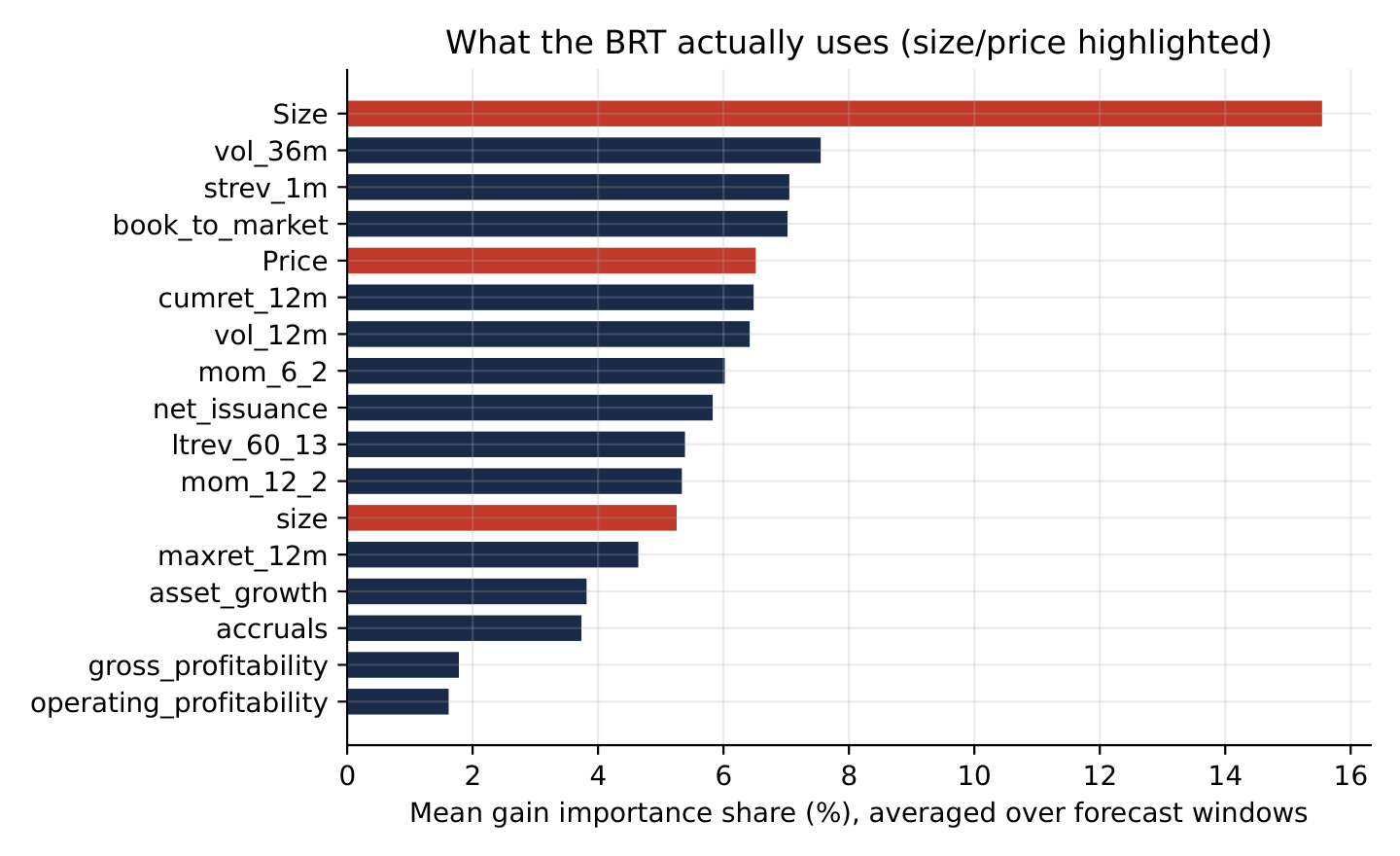
Six standalone quantitative-finance studies: FOMC statement sentiment against a 2-year yield proxy, intraday spectral signatures in SPY and BTC, order-book imbalance as a one-second predictor, a change-point detector bake-off on SPX realized volatility, cross-sectional intraday reversal at multiple horizons, and a public-data replication audit of a real-time equity-ML paper.

Methods
Event studies, NLP sentiment scoring, signal processing, market microstructure, change-point detection, cross-sectional factor research, replication auditing, bootstrap and significance testing, Python
Outcome
A set of careful, reproducible studies, each an honest result about what does and does not hold in intraday, cross-sectional, and risk-signal data.
  • Alternative Data
  • Market Microstructure
  • Risk Signals