Self-Supervised Complex-Wavelet Learning and Statistically Governed Transfer
Scientific Report 3: The V0–V7 Pretraining Ladder, the Transfer Gap, and Phase A
Abstract
Pretext outcomes in this report are training-only evidence (E1-TRAIN); transfer outcomes are observed-validation evidence (E3-VAL). We study whether masked coefficient reconstruction over ERA5 and three historical SST reconstruction products (ERSSTv5, HadISST1, COBE-SST2) improves observed forecast transfer for the coefficient-native persistence-residual Earthformer of Report 2. The V0–V7 ladder improves pretext reconstruction monotonically — the four-store V6 improves all seven tracked holdout diagnostics for every store, and the regional-auxiliary V7 further improves field, equatorial, and Niño-3.4 reconstruction, index MSE, and tendency correlation — yet the gains do not become forecast skill: under an identical supervised fine-tune, V7 worsens all three headline transfer metrics relative to V6 (Niño-3.4 correlation $0.1267\to0.0380$). A coefficient-energy audit shows why fine-scale reconstruction dominates the pretext gradient (highpasses carry $7.98\%$ of isolated Niño-3.4-relevant variance but $98.19\%$ of normalized coefficient loss). Motivated by small unresolvable deltas, the study also installs the project's statistical governance — an append-only consultation ledger, practical minimum effects, and a paired moving-block bootstrap — and runs Phase A, two predeclared consultation batches that freeze a conservative transfer protocol (decoder_last_block, learning rates $10^{-4}/5\times10^{-6}$, epoch-cadence validation, unweighted residual_skill_v0, guarded best-skill selection). Central finding: representation reconstruction improved consistently, but pretext gains did not reliably transfer; the project redirects to supervised forecast-task simulation pretraining (Report 4).
1. Study Identity and Handoff
Study ID R3. Incoming state: the deterministic bottleneck of Report 2. Changed factors: self-supervised data/task scale (V0–V7), then the transfer protocol itself (Phase A). Evidence tiers: E1-TRAIN pretext metrics; E3-VAL transfer comparisons — early ones exploratory, Phase A under the new bootstrap governance. Outgoing protocol (frozen): decoder_last_block; fresh/reused learning rates $10^{-4}/5\times10^{-6}$; validation once per completed epoch; unweighted residual_skill_v0; guarded best_skill.pt selection with Niño-3.4 correlation (leads 3–14) primary. Timeline: 2026-07-01 through 2026-07-03; test never accessed.
2. Introduction
Report 2 located the deterministic bottleneck in the objective/data regime: 335 supervised windows cannot teach a 1.4M-parameter decoder boundary what evolving tropical-Pacific anomalies look like. Masked spatiotemporal coefficient learning is the natural response — reconstruction tasks manufacture supervision from unlabeled sequences, and historical SST reconstructions extend the record by more than a century. Two questions structure the study:
- Do distinct historical SST reconstructions improve multiscale representation quality, measured by masked-coefficient and physical-space reconstruction diagnostics on fixed holdouts?
- Does that quality transfer to phase/amplitude forecasting under a controlled supervised fine-tune?
The answers turn out to be “yes, consistently” and “no, not reliably” — and the divergence between them is the report's central scientific object.
Masked autoencoding is the dominant self-supervised recipe for vision and video [1, 2]: hide most of the input, reconstruct it, and fine-tune the encoder. Its transfer success is typically reported for semantic downstream tasks; whether reconstruction quality transfers to dynamical extrapolation — forecasting — is far less established, and our results bear directly on that question. In climate ML, pretraining has helped when the pretext matched the downstream task: CMIP-pretrained CNNs for ENSO indices [3] and climate-simulation-pretrained ResNets for medium-range fields [4] both pretrain on (approximately) the forecast task itself. Our ladder isolates the complementary case: same architecture, same data modality, but a reconstruction pretext.
A caveat governs all multi-product claims: ERSSTv5 [5], HadISST1 [6], and COBE-SST2 [7] are distinct reconstructions built from substantially shared observations (ICOADS-era ship and buoy records). They diversify reconstruction methodology, gridding, and noise structure — not the set of ENSO events. Store counts below are therefore never read as independent sample sizes.
4. Common Forecast Coordinates
For every transfer comparison: tropical Pacific $30^{\circ}$S–$30^{\circ}$N, $120^{\circ}$E–$280^{\circ}$E on the $24\times48$ grid; 12-month context, 14-month target; observed train 1981–2010; observed validation 2011–2015 (35 windows); 2016–2020 reserved and untouched; cosine-weighted Niño-3.4 box with the leads-3–14 correlation summary; persistence and zero-anomaly baselines. Ensemble size: not applicable. Pretext stores extend earlier than 1981 only (next section).
5. Pretraining Data and Leakage Boundaries
The pretext corpus is: ERA5 1981–2010 training months (never validation/test); ERSSTv5 1854-01–1980-12 (1,524 months, 1951–1980 climatology); HadISST1 1870-01–1980-12 (1,332 months, same climatology interval); COBE-SST2 1850-01–1980-12 (1,572 months). Every external store is declared pretrain_only, is rejected by supervised loaders, and fails closed on any 2011–2020 overlap. Each store carries source-local per-channel normalization: ERSST's $2^{\circ}$ sampling has a different highpass variance profile from ERA5, and applying ERA5 statistics produced an immediately rejected coefficient-scale diagnostic. Manifests record spans, month counts, coefficient/normalization hashes, sealed-period overlap flags, allowed_use, and test_data_read (Table 1).
| Store | Span | Months | Role |
|---|---|---|---|
| ERA5 | 1981-01–2010-12 | 360 | supervised source; training months only |
| ERSSTv5 | 1854-01–1980-12 | 1,524 | pretrain-only; 1951–1980 climatology |
| HadISST1 | 1870-01–1980-12 | 1,332 | pretrain-only; 1951–1980 climatology |
| COBE-SST2 | 1850-01–1980-12 | 1,572 | pretrain-only |
pretrain_only, carries source-local per-channel normalization, and fails closed on any 2011–2020 overlap; the three reconstructions share observational ancestry and are never counted as independent samples.5.1 Store Sampling and Comparability
Sampling modes are proportional, exact-quota balanced, and weighted (largest-remainder); realized per-store batch counts are recorded in checkpoints (e.g. V6: 732/756/732/780 for ERA5/ERSST/HadISST/COBE). Because stores are normalized separately, pooled normalized losses are explicitly marked not strictly comparable across stores; cross-store discussion prioritizes inverse-normalized physical-space RMSE (X2) — field, equatorial band, and Niño-3.4 — which live in common SST-anomaly units.
6. Pretext Tasks and Checkpoint Contract
The pretext model is the same 177-state coefficient-native Earthformer used for forecasting, run at 12-month geometry. Corruption operators are: element masks, whole-month temporal masks, and space–time block masks, plus two-month middle/future gaps in later rungs. With mask set $\mathcal{M}$ and normalized coefficients $z$, the base objective is hidden-only reconstruction,
with validity-masked cells excluded. Physical diagnostics (X2) inverse-normalize and inverse-DTCWT merged predictions to score reconstruction RMSE for the field, equatorial band, and Niño-3.4. Train/holdout sequence partitions are deterministic; a timestamp audit immediately before array materialization rejects any month after 2010-12. Checkpoints round-trip all 177 states exactly; supervised initialization loads 172 tensors with exactly five declared 12-to-14-month temporal-geometry skips, and residual persistence equivalence after zero-output initialization is verified to be exact.
6.1 V0–V6 Reconstruction Ladder
Each rung changes one factor and exact-loads its predecessor:
| Rung | Changed factor | Steps | Selected checkpoint |
|---|---|---|---|
| V1 | ERA5-only masked pretraining | 2,000 | best holdout loss |
| V2 | stronger tasks (block space–time + month gaps) | 3,000 | step 3,000 |
| V3 | + ERSSTv5 store | 1,000$^{\dagger}$ | best holdout loss |
| V4 | exact balanced ERA5/ERSST quotas | 3,000 | step 3,000 |
| V5 | + HadISST1 (three-store balance) | 3,000 | step 2,750 |
| V6 | + COBE-SST2 (four-store balance) | 3,000 | step 3,000 |
| V7 | + regional auxiliary tasks (§6.2) | 3,000 | step 2,500 |
6.2 V7 Regional Phase/Amplitude Auxiliary Task
V7 keeps the masked objective and adds three physical-space regional terms computed only for hidden target months: predicted values at masked locations are merged with visible targets, inverse-normalized with the store's own statistics, inverse-DTCWT'd, and reduced to cosine-weighted indices. With hidden-month index $N_t$, equatorial index $E_t$, and monthly tendency $\Delta N_t = N_t - N_{t-1}$,
The targets remain self-supervised functions of the unlabeled SST sequence; no forecast target, validation month, or supervised optimization enters. The state schema is unchanged, so V7 checkpoints remain compatible with the supervised initialization surgery.
7. Pretraining Results (E1-TRAIN)
The ladder improves nearly monotonically on its fixed holdouts. Selected milestones (pooled unless stated): V1, masked MSE $1.0138\to0.7352$, field reconstruction RMSE $0.1310\to0.0958$; V2, hidden MSE $0.7774\to0.7510$ with full/equatorial/Niño-3.4 RMSE $0.1216/0.1680/0.1627\to0.1174/0.1578/0.1544$; V4 (balanced two-store), pooled hidden $0.7553\to0.7375$ with both stores improving individually; V5 (three-store), pooled hidden $0.6822\to0.6686$, with ERA5 and HadISST improving on all seven tracked diagnostics but small ERSST physical/regional regressions — the one non-monotone rung; V6 (four-store), pooled hidden $0.6990\to0.6693$, field $0.1952\to0.1887$, Niño-3.4 reconstruction $0.2648\to0.2444$, with all seven diagnostics improving for every store and the V5 ERSST regression not persisting. V7 then improves everything its auxiliary targets: field $0.1887\to0.1796$, equatorial $0.2278\to0.2040$, Niño-3.4 reconstruction $0.2444\to0.2063$, index MSE $0.0460\to0.0294$, tendency MSE $0.0378\to0.0271$, tendency correlation $0.8016\to0.8524$ — all ten tracked diagnostics, every store, no cross-source regression. These are representation diagnostics, not forecast skill.
8. Observed Transfer Experiments (E3-VAL)
Three pretrained initializations receive an identical bounded supervised fine-tune (coefficient-native, persistence-residual, decoder_last_block, unweighted residual_skill_v0, 1,000 CUDA steps, guarded selection; all selected step 335):
| Initialization | D1 RMSE | D3 ACC | D4 Niño-3.4 corr | D6 full/eq/Niño-3.4 | 2015 final (${}^{\circ}\mathrm{C}$) |
|---|---|---|---|---|---|
| V2-pretrained | 0.5478 | $+0.2699$ | $+0.0422$ | 0.464/0.462/0.346 | $+0.252$ |
| V6-pretrained | 0.5432 | $\mathbf{+0.2876}$ | $\mathbf{+0.1267}$ | 0.465/0.441/0.320 | $+0.221$ |
| V7-pretrained | 0.5450 | $+0.2768$ | $+0.0380$ | 0.465/0.438/0.319 | $+0.204$ |
| non-pretrained residual (R2) | 0.5922 | $+0.1345$ | $+0.3268$ | 0.482/0.456/0.343 | $+0.352$ |
E3-VAL, exploratory; 2015 values are case-study-only, observed final index $+2.640\,{}^{\circ}\mathrm{C}$). Pretraining improves field RMSE and ACC over the non-pretrained run but costs index correlation; and V7 — the best pretext checkpoint by every diagnostic — is worse than V6 on all three headline metrics.The decisive contrast is V6 versus V7 (Fig. 1): the auxiliary tasks improved exactly the pretext quantities that look forecast-relevant (hidden-month index and tendency reconstruction) and still worsened transfer — Niño-3.4 correlation $0.1267\to0.0380$, ACC $0.2876\to0.2768$, RMSE $0.5432\to0.5450$. Cancellation eased marginally under V7 (cosine $-0.851\to-0.837$; opposing energy $96.2\to95.6\%$) while amplitude stayed damped and 2015 worsened. Reconstruction quality, even regionally targeted, is not the transfer bottleneck.
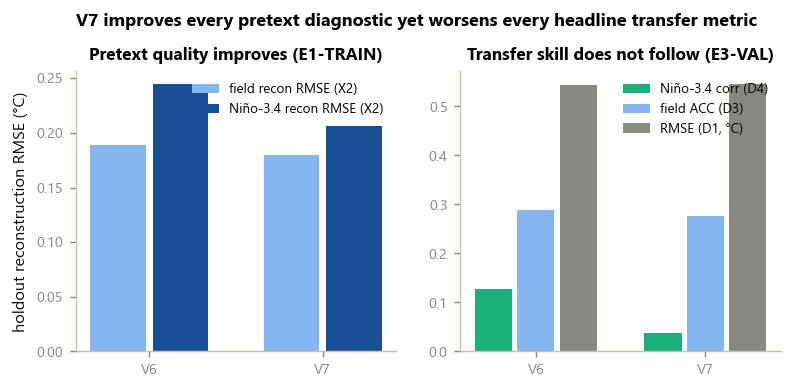
X2; lower is better). Right: the same step worsens every headline transfer metric (D1, D3, D4).9. Measurement and Decision-Governance Reform
Table 2's deltas are small — $0.002\,{}^{\circ}\mathrm{C}$ of RMSE, a few points of correlation — and the study's early rungs were being compared without uncertainty. This forced the governance reform that the rest of the project runs on:
- Append-only consultation ledger. Every observed-validation family comparison is entered before results are inspected, declaring candidate, fixed reference, primary metric, guards, practical minimum effects, bootstrap settings, decision branches, checkpoint-selection source, and the consultations remaining in the phase (budgeted at two per phase for Phases A–D).
- Paired moving-block bootstrap. For metrics recomputed from the same ordered 35 windows in both runs: blocks of 6 consecutive windows, 10,000 resamples, 90% percentile intervals, seed 20260703, identical resampled indices applied to both runs. Aggregate summaries are never expanded into synthetic samples; a missing per-window artifact is reported as missing.
- Decision language. Resolvable improvement requires the CI to exclude zero favorably and the predeclared minimum effect; an interval containing zero is unresolved, never a win or loss. Mixed primary/guard outcomes follow the predeclared branch.
- Selection separation. Checkpoint selection moves off 2011–2015 for Phases B–D (held-out simulations or a frozen training-tail holdout); 2011–2015 is reserved for predeclared family-level comparisons.
- Case-study boundary. The 2015 event may be reported and rendered, but its numbers are never selectors, family criteria, stop rules, or minimum effects.
A retrospective decision-resolvability audit re-examined the ladder's earlier choices under paired bootstrap where artifacts permitted, distinguishing decisions the data actually resolved from those made on unresolved deltas — the direct motivation for Phase A's predeclared design.
10. Phase A Transfer-Protocol Study
Phase A selects a reusable transfer protocol for Phases B–C — not a forecast model — through two predeclared consultation batches under the §9 machinery. Primary: Niño-3.4 correlation, leads 3–14; guards: pooled RMSE and mean-window field ACC; adoption thresholds: primary CI $>0$ with delta $\ge +0.02$, no resolvable RMSE regression $\ge +0.005\,{}^{\circ}\mathrm{C}$, no resolvable ACC regression $\le -0.01$ (Fig. 2).
10.1 A1: Full-Backbone Low-Rate Transfer
Candidates make all 166 optimizable parameters trainable (4 fresh at $10^{-4}$; 162 reused, including 87 encoder parameters, at $10^{-6}$ or $10^{-5}$) against the fixed V7 decoder_last_block reference. Outcomes: lr $10^{-6}$ (selected step 1675) — RMSE $0.5756$, primary delta $+0.219$ $[-0.077,+0.797]$ unresolved, RMSE delta $+0.0306$ $[+0.0174,+0.0430]$ resolvably worse; lr $10^{-5}$ (step 670) — primary $-0.030$ $[-0.388,+0.708]$ unresolved, RMSE $+0.0323$ $[+0.0165,+0.0415]$ resolvably worse. Neither meets the rule; the smaller boundary is retained and the conditional V6 replication branch is not triggered.
10.2 A2: Validation Cadence and Headroom
Report 2's repeated step-335 selections (the first epoch boundary) suggested the fine-tune saturates in one epoch. A2 tests every-84-step validation against epoch cadence on V6. The finer cadence does find a pre-335 within-run peak (selected step 84: RMSE $0.5458$, ACC $+0.2897$, Niño-3.4 $+0.2330$), refining saturation as partly an observation-cadence artifact — but at the family level the primary is unresolved ($+0.106$ $[-0.141,+0.218]$) and the ACC guard resolvably regresses ($-0.0260$ $[-0.0483,-0.0156]$). Epoch cadence is retained.
10.3 A3: Coefficient Energy and Scale Weighting
A training-only audit reconstructs physical maps from isolated coefficient groups (zeroing all others; isolated shares do not allocate cross-group DTCWT covariance). Normalized isolated Niño-3.4-relevant variance shares for lowpass/highpass-1/2/3 are $92.02/0.00/0.42/7.56\%$, while mean normalized coefficient SSE shares across selected V6/V7 checkpoints are $1.81/76.64/17.70/3.84\%$: the highpasses carry $\mathbf{7.98\%}$ of isolated index-relevant variance and $\mathbf{98.19\%}$ of the loss. This triggered the one predeclared scale-weighted run (V7, weighted coefficient MSE): RMSE improved resolvably ($-0.0037$ $[-0.0053,-0.0004]$) but the primary did not resolve ($+0.023$ $[-0.080,+0.127]$), so the unweighted loss remains frozen. The audit's significance outlives Phase A: the same loss-allocation imbalance, remeasured on correction temporal structure, becomes the causal lever of Phase G (Report 8).
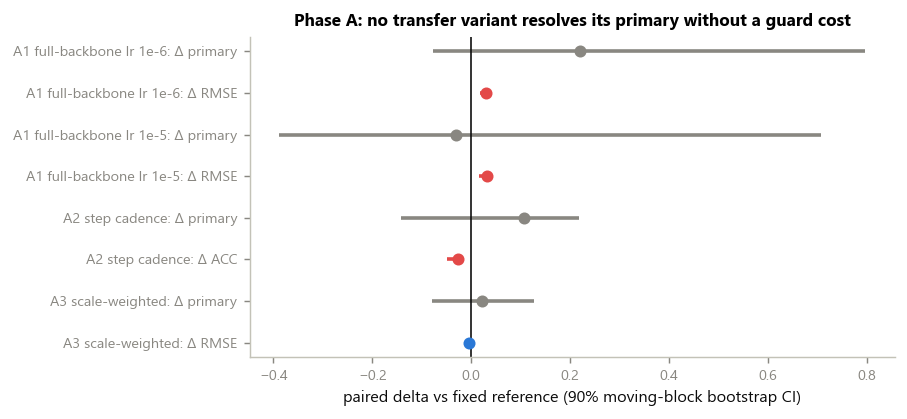
E3-VAL, predeclared). Blue: resolvable in the favorable direction; red: resolvable regression; gray: unresolved. No candidate resolves its primary without a resolvable guard cost, so the conservative protocol is frozen.| Element | Frozen value |
|---|---|
| Trainable boundary | decoder_last_block (53 tensors / 223,621 parameters) |
| Learning rates | $10^{-4}$ fresh / $5\times10^{-6}$ reused |
| Validation cadence | once per completed epoch |
| Objective | unweighted residual_skill_v0 |
| Selection | guarded best_skill.pt; primary Niño-3.4 corr. leads 3–14 |
11. Persistent Series Scorecard
Pretraining (E1-TRAIN): X1 masked-coefficient and X2 physical/regional reconstruction diagnostics by store, as summarized above; per-store values live in the run summaries and cross-source diagnostic reports. Transfers (E3-VAL): Table 2 carries D1–D6; Phase A adds paired deltas and CIs (Fig. 2). X4 provenance: V6 checkpoint SHA-256 5a81ab7a…, V7 16b4a801…; every transfer audit records 172 loaded / 5 skipped tensors, the 53/223,621-parameter trainable boundary, 113/1,193,780 frozen, exact residual-persistence equivalence, and test_data_read: false.
12. Discussion
Why does reconstruction fail to transfer while its diagnostics improve? Four mechanisms are consistent with the record. (i) Objective mismatch: masked reconstruction learns a conditional interpolant of hidden months given visible ones; forecasting requires a conditional extrapolant 14 months forward. The interpolant's sufficient statistics need not contain the extrapolant's. (ii) Fine-scale gradient dominance: with per-channel normalization, $98\%$ of pretext gradient serves bands carrying $8\%$ of index-relevant variance (A3) — representation capacity is spent where the downstream task needs it least. (iii) Normalization and source heterogeneity: store-local statistics preserve each product's variance profile, but the supervised task lives in ERA5's; cross-store averaging can pull shared features toward reconstruction-generic solutions. (iv) Short fine-tuning: 335 windows, one effective epoch of adaptation — but A1/A2 show that opening the backbone or refining cadence does not release the constraint. V7 sharpens the puzzle: a correct local task (hidden-month index and tendency) still fails, because reconstructing a hidden month among visible neighbors is far easier than predicting it from the past alone. The decisive next intervention is supervised forecast-task pretraining at simulation scale — same architecture, same residual target, abundant trajectories — which Report 4 executes.
13. Limitations
Shared observational ancestry across SST products; distinct per-store normalization limiting pooled-loss comparability; unequal effective event counts across stores; a single observed validation slice (35 overlapping windows) consulted repeatedly; adaptive rung-to-rung choices in the ladder (V0–V6 predate the ledger's bootstrap discipline); no random-seed replication of pretraining runs; and bootstrap governance covering transfer comparisons only — pretext metric uncertainty is not quantified. The 2016–2020 split is untouched throughout.
14. Conclusion and Transition to Report 4
The frozen Phase A protocol (Table 3) — decoder_last_block, $10^{-4}/5\times10^{-6}$, epoch cadence, unweighted residual_skill_v0, guarded best-skill selection — is this study's durable product, along with a negative lesson now measured three ways: pretext reconstruction quality, even with regional phase/amplitude auxiliaries, does not become observed forecast skill in this regime. Report 4 inherits the coefficient-native checkpoint bridge, the persistent scorecard, the held-out-selection principle, and the explicit hypothesis that training on the actual 12-to-14-month forecast task across CMIP6 models will transfer where masked reconstruction did not.
References
- K. He, X. Chen, S. Xie, Y. Li, P. Dollár, and R. Girshick, “Masked autoencoders are scalable vision learners,” in IEEE/CVF Conference on Computer Vision and Pattern Recognition, 2022.
- Z. Tong, Y. Song, J. Wang, and L. Wang, “VideoMAE: Masked autoencoders are data-efficient learners for self-supervised video pre-training,” in Advances in Neural Information Processing Systems, vol. 35, 2022.
- Y.-G. Ham, J.-H. Kim, and J.-J. Luo, “Deep learning for multi-year ENSO forecasts,” Nature, 573:568–572, 2019.
- S. Rasp and N. Thuerey, “Data-driven medium-range weather prediction with a ResNet pretrained on climate simulations: A new model for WeatherBench,” Journal of Advances in Modeling Earth Systems, 13:e2020MS002405, 2021.
- B. Huang et al., “Extended Reconstructed Sea Surface Temperature, version 5 (ERSSTv5),” Journal of Climate, 30:8179–8205, 2017.
- N. A. Rayner et al., “Global analyses of sea surface temperature, sea ice, and night marine air temperature since the late nineteenth century,” Journal of Geophysical Research, 108(D14):4407, 2003.
- S. Hirahara, M. Ishii, and Y. Fukuda, “Centennial-scale sea surface temperature analysis and its uncertainty,” Journal of Climate, 27:57–75, 2014.