Simulation-Scale Supervised Pretraining for Sealed Deterministic ENSO Skill
Scientific Report 4: Phase B, the PB-1 Transfer, and the First Hash-Gated Test
Abstract
Simulation results here are held-out climate-model evidence (E2-SIM), PB-1's selection is observed-validation evidence (E3-VAL), and the final result is the project's pristine sealed-test evidence (E4a-TEST). We test whether supervised forecast-task pretraining on CMIP6 historical simulations can overcome the observed transfer gap documented in Report 3. Eleven CMIP6 source models train a coefficient-native persistence-residual Earthformer on the exact 12-to-14-month forecast task (21,505 balanced windows); three whole source models (GFDL-ESM4, MCM-UA-1-0, MRI-ESM2-0) are held out for all checkpoint selection. Exact-continuation training to 30k steps (v1$\to$v2$\to$v3) shows an early held-out primary peak, late selector divergence, and broad late held-out overfit — grounds to stop simulation training. The predeclared PB-1 consultation then compares two transfers of the selected v3 backbone against the fixed V6 reference under the frozen Phase A protocol: the features-only zero-output transfer wins with the project's first resolvable observed primary improvement (Niño-3.4 correlation delta $+0.489$, 90% CI $[+0.256,+0.857]$; validation RMSE $0.5407$, ACC $+0.3579$, Niño-3.4 correlation $+0.6157$). After Phases C and D were evaluated and rejected on validation, a written protocol froze PB-1 as the single final model and authorized exactly one hash-gated evaluation of the sealed 2016–2020 split. That evaluation returned pooled field RMSE $0.5406$ versus persistence $0.6591$ and zero anomaly $0.6200$ (paired delta $-0.1185$, 90% CI $[-0.1561,-0.0858]$); $35/35$ windows beating persistence and $14/14$ leads beating zero; field ACC $+0.2553$; Niño-3.4 correlation $+0.3432$; and amplitude ratios $0.408/0.398/0.411$ — confirmed pattern and phase skill with persistent amplitude damping.
1. Study Identity and Handoff
Study ID R4 / Phase B. Incoming state: the frozen Phase A transfer protocol and the V6 reference from Report 3. Changed factor: supervised forecast-task exposure at simulation scale. Evidence tiers: E2-SIM pretraining and budget study; E3-VAL predeclared transfer consultation; E4a-TEST final result. Outgoing baseline: immutable PB-1 (checkpoint SHA-256 c6b49723…) for Reports 5–8. Timeline note: reading order is thematic — the Phase C and Phase D studies of Reports 5–6 were executed after PB-1 selection but before this report's test section, and Phase E onward came after it. Phase B itself spans 2026-07-03 to 2026-07-05; the test read is 2026-07-06.
2. Introduction
Report 3 ended with a measured negative: masked reconstruction, even with regional auxiliaries, improved representation diagnostics without improving forecasts. The natural alternative inverts the pretext: train on the target task itself — 12 months in, 14 months out, persistence-residual, same loss — using the only source of abundant tropical-Pacific trajectories available: coupled climate simulations. The sim-to-real hypothesis is that model trajectories, despite simulation bias, teach forecastable ENSO evolution, provided checkpoint selection stays on held-out source models and the observed transfer is governed as tightly as Phase A prescribed. Precedent exists at the index level [1] and for medium-range fields [2]; the contribution here is the field-level, coefficient-native instance with explicit statistical governance and a sealed confirmatory endpoint.
Climate-simulation pretraining entered ENSO deep learning with [1], which trained a CNN on CMIP historical simulations and SODA-era reanalysis before fine-tuning; [2] showed the same lever for gridded medium-range prediction; and transformer-based Earth system models routinely assume large training corpora [3]. Three practices distinguish this study. Source-model holdout: selection uses whole held-out models — generalization across model physics, not across windows of one model. Exact continuation: v1$\to$v2$\to$v3 resume model, optimizer, sampler position, and RNG state bit-exactly, making the 10k/20k/30k budget study a single controlled trajectory. Residual initialization and sealed evaluation: the zero-output transfer preserves exact persistence at step 0 on observations, and the endpoint is a one-shot, hash-gated test governed by a frozen written protocol [5]. The study is a task-alignment and evidence-governance experiment, not a comprehensive ENSO benchmark.
4. Common Forecast Coordinates
Observed: $24\times48$ tropical Pacific ($30^{\circ}$S–$30^{\circ}$N, $120^{\circ}$E–$280^{\circ}$E); 12 context / 14 target months; train 1981–2010; validation 2011–2015 (35 windows); sealed test 2016–2020 (35 windows); cosine-weighted Niño-3.4 box, leads-3–14 summary; persistence and zero-anomaly baselines. CMIP uses analogous geometry but realization-local detrending, climatology, and normalization; simulation scores are therefore not absolute counterparts of ERA5 scores, and the CMIP selector's Niño-3.4 correlation (flattening windows and leads) is not numerically identical to the observed D4 statistic.
5. CMIP6 Data and Source-Model Boundary
Discovery against the public Pangeo CMIP6 catalog (CMIP/historical/Omon/tos/r1i1p1f1) on 2026-07-03 returned 57 candidate datasets across 50 source models; metadata inspection rejected curvilinear and unstructured grids, incomplete 1850–2014 coverage, and unit problems, leaving 14 complete rectilinear stores [4]. Each realization is processed independently: longitude normalization; selection of $30^{\circ}$S–$30^{\circ}$N, $120^{\circ}$E–$280^{\circ}$E with an interpolation halo; regrid to $24\times48$; Celsius conversion; cell-wise linear detrending fit over 1850–2014 with calendar-month fixed effects, applied before climatology; subtraction of a 1900–1999 realization-local monthly climatology; three-level DTCWT packing; and store-local per-channel normalization. Every store spans 1,980 months with coefficient geometry $[1980,24,48,37]$, carries allowed_use: pretrain_forecast and simulation_calendar: true, and is rejected by observed supervised loaders. Training balances windows by source_id (equal 1,955-window quotas), giving 21,505 train and 5,865 held-out windows.
5.1 Training and Held-Out Models
Eleven source models train: CESM2, CESM2-FV2, CESM2-WACCM, CESM2-WACCM-FV2, E3SM-1-0, E3SM-1-1, E3SM-1-1-ECA, GFDL-CM4, GISS-E2-1-G, GISS-E2-1-G-CC, GISS-E2-1-H. Three are held out whole: GFDL-ESM4, MCM-UA-1-0, and MRI-ESM2-0 — MRI and MCM are family-unique in the compatible set, and GFDL supplies a third institution (its relation to GFDL-CM4 is the documented compromise required for a three-model holdout). Whole-source holdout matters because windows within one realization are highly dependent; aggregation weights models equally so no source dominates silently. All Phase B checkpoint decisions use these three models only, consuming zero observed-validation consultations (Table 1).
| Role | Source models (historical r1i1p1f1, one per source) | Windows |
|---|---|---|
| Training (11) | CESM2, CESM2-FV2, CESM2-WACCM, CESM2-WACCM-FV2; E3SM-1-0, E3SM-1-1, E3SM-1-1-ECA; GFDL-CM4; GISS-E2-1-G, GISS-E2-1-G-CC, GISS-E2-1-H | 21,505 |
| Held out (3) | GFDL-ESM4 (shares an institution with GFDL-CM4 — the documented compromise); MCM-UA-1-0 and MRI-ESM2-0 (family-unique) | 5,865 |
6. Forecast-Pretraining Method
The model, target, and loss are exactly Report 2's supervised configuration — coefficient-native Earthformer $[12,24,48,37]\to[14,24,48,37]$, persistence-residual target, unweighted residual_skill_v0 — with one difference declared in advance: all 166 optimizable tensors train in simulation (pretraining does not authorize observed full-backbone unfreezing; the observed transfer retains the frozen Phase A boundary). AdamW at $10^{-4}$, batch 1, balanced source sampling. Stage continuations resume last.pt exactly — model, optimizer, deterministic sampler position, and Python/NumPy/CPU/CUDA RNG state — so v1 (0–10k), v2 (10k–20k), and v3 (20k–30k) form one uninterrupted optimization trajectory with recorded stage hashes.
7. Simulation Experiments (E2-SIM)
7.1 Pilot and Expanded V1
A six-train/two-holdout real pilot (1,000 CUDA steps) validated ingestion, dataset, shape, and checkpoint paths (selected checkpoint held-out Niño-3.4 correlation $0.509$). The expanded v1 trained 10,000 steps on the 11/3 split: selected step 5,000 with aggregate coefficient RMSE $1.1739$, field RMSE $0.6579$, field ACC $0.2730$, Niño-3.4 correlation $0.5644$ — against held-out persistence field RMSE $0.7418$ (correlation $0.3183$) and zero-anomaly $0.6364$. Variability ratios $0.828/0.771/0.742$: simulation training preserves far more amplitude than any observed fine-tune of Reports 2–3.
7.2 V2 Exact Continuation to 20k
V2 selected stage step 1,000 (global 11,000): Niño-3.4 correlation $0.5854$ ($+0.0211$ over v1), field RMSE $0.6442$ ($-0.0137$), ACC $0.2965$ ($+0.0236$), variability $0.829/0.838/0.816$. The primary then oscillated, ending at $0.5728$ at global 20,000 — an early-peak/late-regression warning, but not broad degradation (end-stage RMSE and ACC improved).
7.3 V3 Exact Continuation to 30k
V3 retained global step 21,000 (SHA-256 2247c1f9…): Niño-3.4 correlation $0.5835$ ($-0.0019$ vs v2 — the primary has stopped improving), coefficient RMSE $1.1112$, field RMSE $0.6214$ (crossing below the zero baseline by $0.0149$ for the first time), ACC $0.3015$, but variability ratios worsened to $0.765/0.777/0.752$. Selector divergence appeared: the composite-loss and field-RMSE selectors both chose global 24,000 (RMSE $0.6187$, correlation $0.5720$), while the global-30,000 endpoint's primary fell to $0.5355$ — broad late held-out overfit relative to the early peak (Fig. 1). Per-model v3 primaries: GFDL-ESM4 $0.574$, MCM-UA-1-0 $0.465$, MRI-ESM2-0 $0.668$. Decision: stop simulation training; proceed to the predeclared observed consultation from the v3 selected state.
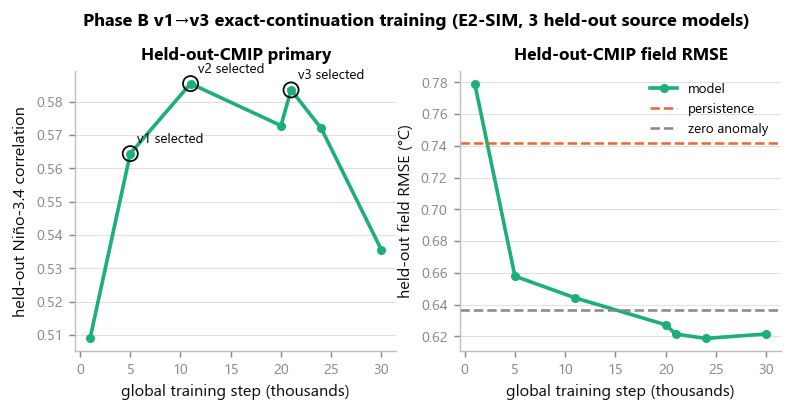
E2-SIM). Left: the held-out primary peaks early in each stage and declines late (30k endpoint $0.5355$). Right: held-out field RMSE improves monotonically, crossing the zero-anomaly baseline in v3 — selector divergence that justifies stopping.8. PB-1 Observed Transfer Study (E3-VAL)
The consultation was predeclared in the ledger before any candidate ran: two transfers of v3's selected backbone against the fixed V6 pretrained reference, both under the frozen Phase A protocol (decoder_last_block, $10^{-4}/5\times10^{-6}$, epoch cadence, unweighted loss, guarded selection). The candidates differ only in residual-head handling: head-preserving (none: the pretrained residual head transfers, so no step-zero persistence equivalence, recorded as not applicable) and features-only (zero_output: the residual head is re-zeroed, exact persistence at step 0). Adoption rule: primary CI $>0$ with delta $\ge +0.02$, no resolvable pooled-RMSE regression $\ge +0.005\,{}^{\circ}\mathrm{C}$, no resolvable mean-window-ACC regression $\le -0.01$; branches for unresolved and resolvably-worse outcomes were declared with it. Bootstrap: paired moving blocks of 6, 10,000 resamples, 90%, seed 20260703.
8.1 Validation Outcome and Selection
Both 1,000-step CUDA fine-tunes completed; for the first time the selection metric did not saturate at the first epoch boundary (zero_output peaked at step 670; none improved through step 1,000). Selected zero_output validation: RMSE $0.540731$, mean field ACC $+0.357874$, Niño-3.4 correlation $+0.615723$. Paired against V6: primary $\mathbf{+0.488977}$, CI $[+0.256068,+0.857422]$ — the first resolvable observed primary improvement in the project record; RMSE $-0.002497$ $[-0.020406,+0.012208]$ unresolved; mean-window ACC $+0.041523$ $[+0.009528,+0.087033]$ resolvably better (Fig. 2). The none candidate also passed the rule (primary $+0.313891$ $[+0.136393,+0.749443]$) but is dominated on primary and both guards. Declared diagnostics: the full-field amplitude ratio resolvably decreased ($-0.1009$) while the Niño-3.4 ratio resolvably increased ($+0.1090$); the 2015 case remained worse than persistence ($0.7922$ vs $0.7420$, case-study-only). Decision: adopt the features-only transfer as PB-1 (best_skill.pt, step 670, SHA-256 c6b49723…); the second Phase B consultation was not consumed.
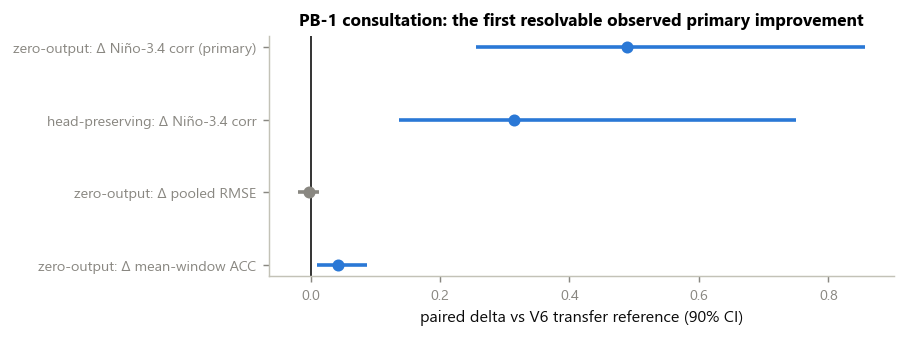
E3-VAL; 90% paired moving-block CIs). The zero-output transfer meets the full adoption rule: resolvable primary, unresolved RMSE, resolvably improved ACC.9. Selection Exhaustion and Final-Test Gate
Between PB-1's adoption and the test read, two further phases ran to completion on validation and were rejected: Phase C (OHC300 input; Report 5) and Phase D (per-coefficient Gaussian heads; Report 6, first half). Both consumed their predeclared consultations; PB-1 remained the single surviving model. On 2026-07-06 — before any 2016–2020 month was materialized — the final protocol was frozen in writing: exactly one evaluation of exactly one model (PB-1, named by full checkpoint SHA-256), plus persistence and zero-anomaly baselines (which consume no budget); the complete metric list with bootstrap settings; the rule that everything is reported favorable or not and that no test number ever selects, tunes, or gates anything; and a recorded honest expectation (“comparable modest skill”). The evaluator itself is fail-closed: it refuses to materialize test months unless the protocol file exists and its declared SHA-256 matches the checkpoint under evaluation.
10. First PB-1 Sealed-Test Result (E4a-TEST)
The single authorized evaluation ran on 2026-07-06 (35 windows):
| Metric (2016–2020, 35 windows) | PB-1 | Persistence | Zero anomaly |
|---|---|---|---|
| Pooled field RMSE (${}^{\circ}\mathrm{C}$) | 0.5406 | 0.6591 | 0.6200 |
| Paired $\Delta$ vs persistence | $-0.1185$, 90% CI $[-0.1561,-0.0858]$ (resolvable) | ||
| Windows beating persistence | 35 / 35 | — | — |
| Leads beating zero anomaly | 14 / 14 | — | — |
| Mean field ACC | $\mathbf{+0.2553}$ | $+0.2292$ | undefined |
| Niño-3.4 correlation, leads 3–14 | $\mathbf{+0.3432}$ | $-0.015$ | undefined |
| Amplitude ratios (full/eq/Niño-3.4) | 0.408/0.398/0.411 | $\approx1$ | 0 |
E4a-TEST). Persistence field ACC and Niño-3.4 correlation from the evaluation artifact's skill block; the CI attaches to RMSE versus persistence per the frozen protocol.Leadwise structure appears in Fig. 3: PB-1 trails persistence only at lead 1 (where persistence is nearly perfect by construction), beats it at every later lead, and holds positive Niño-3.4 correlation through lead 14.
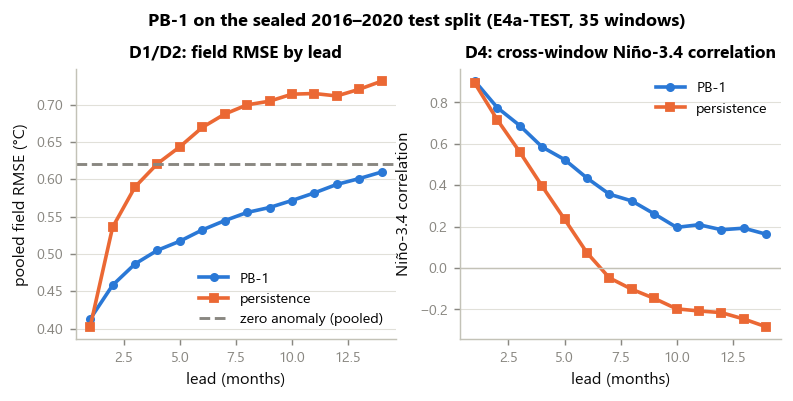
E4a-TEST): pooled field RMSE by lead against persistence and the pooled zero-anomaly level (left); cross-window Niño-3.4 correlation by lead (right).10.1 Interpretation
The positive field ACC and Niño-3.4 correlation are what make Table 2 more than a climatology-like win: Report 2 documented models that beat both baselines on RMSE with zero pattern correlation, and PB-1 is not that. Simultaneously, the amplitude ratios ($\approx0.41$) record the persistent damping the deterministic frame imposes — the exact limitation the probabilistic program (Reports 6–8) subsequently attacks. Event-specific test behavior is reported descriptively only, and nothing in the test result was used to select or tune anything afterward.
11. Persistent Series Scorecard
The three evidence blocks are kept separate. E2-SIM: v1/v2/v3 selected rows (field RMSE $0.6579/0.6442/0.6214$; Niño-3.4 correlation $0.5644/0.5854/0.5835$; variability $0.83/0.83/0.76$ full-field), with persistence $0.7418$ and zero $0.6364$ on the same holdout. E3-VAL: PB-1 selected validation row (RMSE $0.5407$, ACC $+0.3579$, Niño-3.4 $+0.6157$) with the paired deltas of Fig. 2. E4a-TEST: Table 2, where the CI attaches to RMSE versus persistence only — other test CIs would require documented recomputation from the preserved per-window records. X4: v1 selected 10d8319b…; v2 3c822401…; v3 2247c1f9… (plus guardrail 36550518…/a4034ad5…); PB-1 c6b49723…; stage runtimes 4,944/4,767/5,464 s; exact 177-state reloads at every stage; test_data_read: false in every artifact before the authorized read.
12. Discussion
Why did supervised task alignment transfer where reconstruction did not? The pretraining gradient now points at the downstream object itself — the conditional distribution of a 14-month future given a 12-month past — so the representation is organized around forecastable evolution rather than interpolation. Simulation scale (21,505 windows versus 335) provides the event diversity the observed record cannot.
Why did features-only transfer dominate head preservation? The pretrained residual head encodes CMIP-calibrated correction magnitudes in store-local normalized units; zeroing it lets observed fine-tuning rebuild the output map from exact persistence while keeping the pretrained features — initialization bias where it helps, none where it binds.
Why did simulation selectors diverge late? Long training overfits the held-out models unevenly across metrics: coefficient/field losses keep improving while the cross-window index correlation — the quantity closest to the observed primary — peaks early. Treating the primary's early peak as the selection signal, with RMSE/ACC as guards, is what the frozen policy prescribed, and the observed transfer result vindicates it.
What does the sealed test establish? That the core hypothesis — forecasting complete complex-wavelet coefficient maps with an Earthformer backbone yields real tropical-Pacific SST skill — holds on truly sealed data, with effect size comparable to its validation estimate (RMSE $0.5407$ validation vs $0.5406$ test against a harder persistence baseline).
13. Limitations
Climate-model dependence and shared CMIP biases; only three held-out source models (one sharing an institution with a training model); simulation metrics aggregated differently from observed metrics (flattened correlation; realization-local normalization); ERA5 as the observational target rather than independent in-situ products; a modest baseline suite; persistent amplitude damping; a single five-year test period; and no authorization to reuse the test result for later probabilistic selection. A separately predeclared bounded amendment was later exercised once by G2-long (Report 8); it did not alter PB-1's result and fully spent the split.
14. Conclusion and Transition
Supervised CMIP6 forecast-task pretraining produced the project's strongest pristine sealed result: resolvable held-out field skill with positive pattern and phase correlation, from a training recipe whose every selection decision is documented and whose test access was governed by a written one-shot gate. PB-1 is hereafter immutable — the SST-only deterministic mean reference for every subsequent report. Two questions leave this report open: whether subsurface predictors can add transferable information (Report 5, answered in the negative), and whether the damped amplitude can be cured probabilistically (Reports 6–8). Neither question carries test authority; Report 8 documents the separate second and final amended consultation.
References
- Y.-G. Ham, J.-H. Kim, and J.-J. Luo, “Deep learning for multi-year ENSO forecasts,” Nature, 573:568–572, 2019.
- S. Rasp and N. Thuerey, “Data-driven medium-range weather prediction with a ResNet pretrained on climate simulations: A new model for WeatherBench,” Journal of Advances in Modeling Earth Systems, 13:e2020MS002405, 2021.
- Z. Gao, X. Shi, H. Wang, Y. Zhu, Y. Wang, M. Li, and D.-Y. Yeung, “Earthformer: Exploring space-time transformers for Earth system forecasting,” in Advances in Neural Information Processing Systems, vol. 35, 2022.
- V. Eyring et al., “Overview of the Coupled Model Intercomparison Project Phase 6 (CMIP6) experimental design and organization,” Geoscientific Model Development, 9:1937–1958, 2016.
- T. Gneiting and A. E. Raftery, “Strictly proper scoring rules, prediction, and estimation,” Journal of the American Statistical Association, 102:359–378, 2007.