Cross-Domain Transfer of Upper-Ocean Heat-Content Predictors
Scientific Report 5: A Controlled OHC300 Negative Study (Phase C)
Abstract
Held-out-simulation outcomes here are E2-SIM; observed transfer outcomes are E3-VAL. We ask whether upper-300 m ocean heat content (OHC300) adds transferable information to the PB-1 SST pathway. A 74-channel coefficient-native model (37 SST + 37 OHC DTCWT channels in, 37 SST channels out) is pretrained on paired CMIP6 SST/OHC300 stores under the Phase B protocol and fine-tuned on observations with GODAS-derived OHC300, against equal-budget SST-only twins that zero the OHC input while keeping the identical pretraining lineage. Within simulation, OHC helps: at equal 30k budget the SST+OHC backbone reaches held-out CMIP Niño-3.4 correlation $\approx0.610$ versus $0.584$ for the SST-only Phase B backbone. On observations it does not transfer — and actively hurts. The first consultation exposed a pretraining-budget confound (10k vs 30k) and, per the predeclared branch, triggered the fair-budget iteration; the second and final consultation at equal 30k budget isolated the input causally: using observed GODAS OHC resolvably degrades Niño-3.4 correlation ($-0.126$, 90% CI $[-0.209,-0.021]$), mean-window field ACC ($-0.080$, CI $[-0.140,-0.056]$), and pooled RMSE ($+0.016$, CI $[+0.012,+0.032]$) relative to zeroing it, while the SST-only twin remains comparable to PB-1 — so the lineage is sound and the observed OHC input is the harm. Phase C is closed as a rigorous negative: naive coefficient concatenation of a simulation-trained subsurface predictor does not survive the simulation-to-observation boundary. PB-1 is retained.
1. Study Identity and Handoff
Study ID R5 / Phase C. Incoming baseline: PB-1 (Report 4). Changed factor: add OHC300 context channels while retaining SST targets, the frozen transfer recipe, and (after the confound iteration) the pretraining budget. Evidence tiers: E2-SIM and E3-VAL only; no test access. Terminal decision: reject naive OHC concatenation; retain PB-1 for Report 6. Timeline: 2026-07-06, after PB-1 selection and before the E4a test read; both predeclared Phase C consultations were consumed.
2. Introduction
Subsurface heat content is the canonical slow variable of ENSO dynamics. In the recharge-oscillator description, equatorial warm-water volume builds before warm events and discharges through them [1], and observed warm-water volume leads Niño-3.4 SST by roughly two to three seasons [2] — long enough, in principle, to extend a 14-month forecast's usable horizon. If any additional predictor should help this system, it is this one.
The question, posed precisely, is not whether OHC carries ENSO signal — it does, in theory and in our simulations — but whether a predictor that improves held-out climate-model forecasting retains its benefit when the observed counterpart of that predictor comes from an ocean reanalysis (GODAS) with its own assimilation physics, climatology, and error structure. That is a simulation-to-observation transfer question, and Phase C is built as a controlled experiment on exactly that boundary.
The recharge/discharge paradigm [1] and its observational confirmation via warm-water volume [2] motivate subsurface predictors for statistical and ML ENSO forecasting alike; operational analyses routinely monitor upper-ocean heat content as an ENSO precursor. Ocean reanalyses, however, disagree substantially on subsurface heat-content variability, especially before Argo [4]: the observed “ground truth” for OHC is itself a model product (GODAS assimilates profiles into an ocean model [3]), so a simulation-trained OHC pathway faces distribution shift on both sides of the transfer. CMIP6 models likewise differ from observations in thermocline sharpness, ENSO amplitude, and the phase relation between heat content and SST [5]. The literature thus supplies both the hypothesis and the specific risk this study is designed to isolate; multimodal fusion practice in ML (channel concatenation of co-registered fields) supplies the naive mechanism under test.
4. Data
Simulation and observed OHC products are described separately because their mismatch is central to the interpretation.
4.1 CMIP6 SST and OHC300
For each of the 14 Phase B source realizations, ocean potential temperature (thetao) is ingested, cropped to the domain before vertical reduction, and reduced by depth/thickness-weighted integration over the upper 300 m:
i.e. a thickness-weighted mean temperature of the upper 300 m (proportional to heat content up to constants). The result is paired 1:1 with the Phase B SST stores under identical policy: realization-local detrending, 1900–1999 climatology, $24\times48$ regrid, three-level DTCWT packing, store-local normalization, and the same 11-train/3-held-out source split.
4.2 Observed ERA5 and GODAS
Observed OHC300 is built from GODAS potential-temperature files [3] by the same reduction (1), timestamp-aligned with ERA5 SST, masked, and sealed to 1981–2015 (420 months): no 2016–2020 OHC material exists in the study. GODAS differs from CMIP OHC in assimilation constraints, mean thermocline structure, variance, and trend handling — the distribution shift under test.
4.3 Common Forecast Coordinates
As in the series: $24\times48$ tropical Pacific, 12/14-month geometry, observed train 1981–2010, validation 2011–2015 (35 windows), 2016–2020 reserved and untouched, cosine-weighted Niño-3.4 with leads-3–14 summary, persistence and zero-anomaly baselines. Ensemble size: not applicable.
5. Model and Controlled Ablation
The candidate consumes 74 input channels — the 37 SST coefficients concatenated with the 37 OHC coefficients — through a fresh first convolution, with the coefficient-native backbone and the unchanged 37-channel SST output head; targets, loss, and the frozen transfer protocol are exactly PB-1's.
The decisive control is the sst_only twin: the identical OHC-lineage model — same pretrained weights, same fine-tune recipe, same budget — with the OHC input channels zeroed at transfer time. The twin separates two confounded explanations for any candidate-versus-PB-1 difference: pretraining lineage (different backbone history) versus input information (what observed OHC actually contributes). Candidate-minus-twin isolates the input; twin-minus-PB-1 isolates the lineage (Fig. 1).
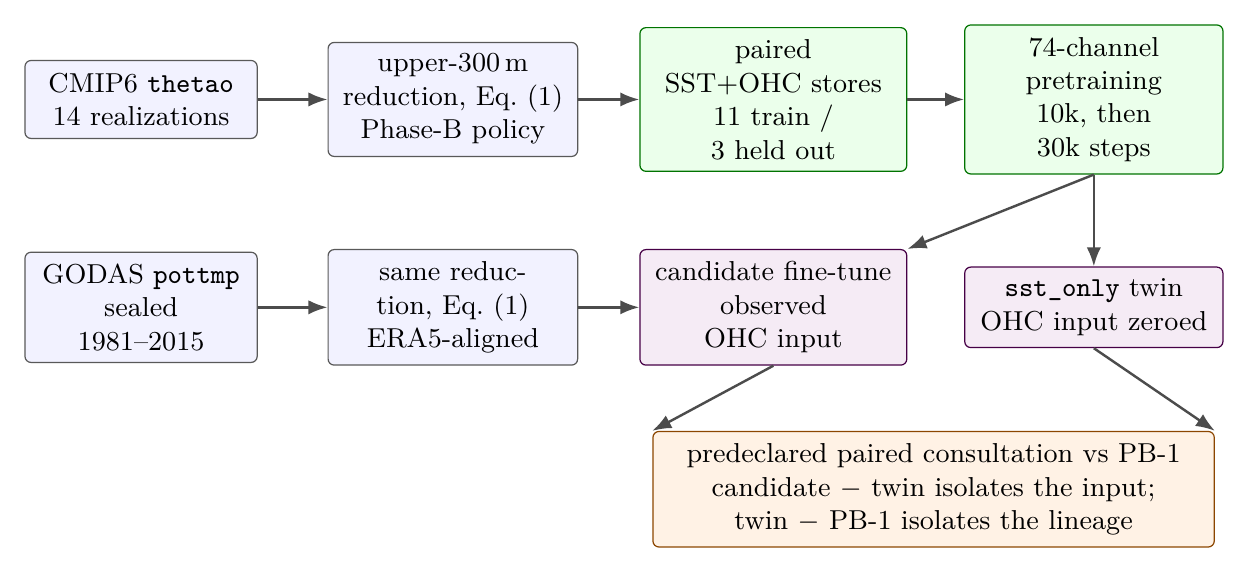
sst_only twin share pretrained weights, recipe, and budget, differing only in whether the observed OHC channels are read or zeroed.6. Experimental Design and Gates
The predeclared consultation (ledger, 2026-07-06) fixes: reference PB-1; primary Niño-3.4 correlation leads 3–14; guards pooled RMSE and mean-window ACC; adoption thresholds identical to PB-1's (primary CI $>0$, delta $\ge+0.02$, no resolvable RMSE $\ge+0.005\,{}^{\circ}\mathrm{C}$ or ACC $\le-0.01$ regression); paired moving-block bootstrap (block 6, 10,000 resamples, 90%, seed 20260703); and the two-consultation branch structure — if the candidate is unresolved without resolvable guard regression, one data/budget iteration is authorized as the second and final consultation. The first candidate carried a known asymmetry: its backbone had 10k pretraining steps versus PB-1's 30k (v1$\to$v3), a budget confound the design anticipated.
7. Results
7.1 Within-Simulation OHC Signal (E2-SIM)
At equal 30k budget, the paired SST+OHC backbone improves held-out CMIP forecasting: Niño-3.4 correlation $\approx\mathbf{0.610}$ versus $0.584$ for the SST-only Phase B v3 backbone, with per-model and aggregate metrics improving. The flattened simulation correlation estimator is not numerically comparable to observed D4, but the within-simulation direction is unambiguous: the subsurface field carries usable predictive signal for this architecture when train and test share model physics.
7.2 First Observed Consultation: Budget Confound
The 10k OHC candidate lost to PB-1 on the primary — Niño-3.4 correlation $0.3985$ vs $0.6157$, delta $-0.2172$, CI $[-0.2781,-0.0576]$, resolvably worse — with unresolved guards (RMSE $-0.0058$; ACC $-0.0304$). But its equal-10k sst_only twin shows the OHC input was not the problem at that budget: within the 10k lineage, OHC resolvably improved pooled RMSE ($-0.0063$, CI $[-0.0084,-0.0008]$) and nudged the primary ($+0.0505$, unresolved $[-0.126,+0.118]$). The candidate lost because of three-fold less pretraining, not because of OHC. Per the predeclared branch, this triggered the one data-volume iteration: extend OHC pretraining to 30k and re-consult.
7.3 Second Observed Consultation: Equal-Budget Isolation
At matched 30k budget the picture inverts (Fig. 2). Against PB-1, the OHC candidate is not better (primary $0.4547$ vs $0.6157$; delta $-0.161$, CI $[-0.266,+0.023]$ unresolved) and is resolvably worse on both guards (ACC $-0.122$; RMSE $+0.012$). The causal isolation is candidate-versus-twin: feeding observed GODAS OHC, relative to zeroing it,
Paired delta (OHC $-$ sst_only, 30k) | Point | 90% CI |
|---|---|---|
| Niño-3.4 correlation, leads 3–14 | $-0.126$ | $[-0.209, -0.021]$ |
| Mean-window field ACC | $-0.0799$ | $[-0.1401, -0.0561]$ |
| Pooled field RMSE (${}^{\circ}\mathrm{C}$) | $+0.0165$ | $[+0.0121, +0.0324]$ |
— all three resolvable, all three unfavorable. Meanwhile the twin itself is comparable to PB-1 (Niño-3.4 correlation $0.5808$ vs $0.6157$), confirming the OHC pretraining lineage is sound. The observed OHC input is what hurts.
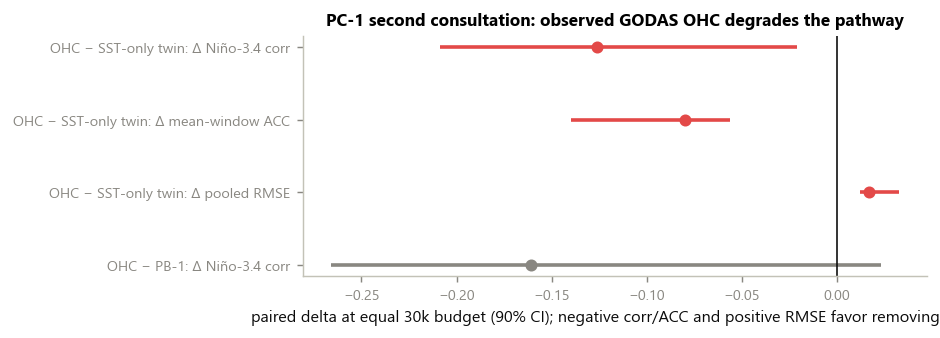
E3-VAL; 90% paired CIs). Every OHC-versus-twin delta is resolvable and unfavorable; the OHC-versus-PB-1 primary is unresolved with resolvably worse guards. Bottom: the sign of the OHC effect on Niño-3.4 correlation flips across the simulation-to-observation boundary — the study's one-figure summary.8. Persistent Series Scorecard
| Badge | Model | D1 RMSE | D3$^{\ast}$ ACC | D4 Niño-3.4 | note |
|---|---|---|---|---|---|
| E2-SIM | SST-only v3 (held-out CMIP) | 0.6214 | 0.302 | 0.584 | Phase B selected |
| E2-SIM | SST+OHC 30k (held-out CMIP) | — | — | 0.610 | OHC helps in-sim |
| E3-VAL | PB-1 (reference) | 0.5407 | 0.358 | 0.6157 | frozen |
| E3-VAL | OHC candidate 10k | 0.5349$^{\dagger}$ | — | 0.3985 | budget-confounded |
| E3-VAL | OHC candidate 30k | +0.012 vs PB-1 | $-0.122$ vs PB-1 | 0.4547 | guards resolvably worse |
| E3-VAL | sst_only twin 30k | — | — | 0.5808 | lineage sound |
X4: candidate/twin checkpoints e4dba1fc…/ a0865797… (10k) and 358ac849…/c08e2e07… (30k); GODAS store sealed 1981–2015; test_data_read: false throughout; 2015 case values (OHC $0.7786$/$0.7837$ vs persistence $0.742$) recorded as case-study-only.
9. Distribution-Shift Analysis
The demonstrated outcome is that observed OHC input harms this pathway; the mechanism — simulation-to-observation distribution mismatch — is inferred from converging circumstantial evidence rather than a single decisive diagnostic. The candidate's OHC$\to$SST pathway was fit entirely on CMIP statistics: realization-local climatologies and trends, model thermocline structure, and model-specific OHC–SST phase relations. GODAS OHC differs in all of these — assimilation-constrained variance, different mean state and trend treatment, and product-specific noise — so the transferred pathway reads observed OHC through mis-calibrated weights and injects error rather than lead information. Consistent with this reading: the same pathway helps when train and evaluation share model physics (E2-SIM); the harm survives budget matching; and the twin construction rules out lineage effects. A planned next-pass addition is a direct comparison of coefficient-space distributions (per-channel variance profiles, regional means/variances, missingness, and conditional OHC–SST response) between the CMIP training pool and GODAS; the ingestion reports contain the required statistics.
10. Discussion
The result argues against naive coefficient concatenation, not against subsurface predictors as such. The physics that motivated the study is intact — OHC300 demonstrably helps within simulation — and the failure is located at the product boundary. Constructive variants, each a properly separate future study: (i) bias-correcting observed OHC toward the simulation distribution (quantile mapping per channel) before the transferred pathway reads it; (ii) pretraining the OHC pathway on an observation-consistent ocean reanalysis ensemble rather than CMIP; (iii) collapsing OHC to low-dimensional summaries with robust cross-product meaning (warm-water volume, equatorial mean thermocline depth) instead of full coefficient maps; (iv) learned cross-product alignment (adapters fit on the overlap period); and (v) targeted low-mode conditioning, where OHC informs only the coherent basin-scale modes that Report 7 shows carry the index error. Each inherits this report's twin design as its control.
11. Limitations
One observed OHC product (GODAS) — reanalysis disagreement [4] means another product could transfer differently; 0–300 m mean-temperature aggregation discards vertical structure; no salinity/dynamic-height information; three held-out CMIP models; 35 overlapping validation windows; a two-stage adaptive design (the budget iteration was predeclared but still uses the validation split twice); and no test access. Within-simulation improvement cannot validate observational transfer — that asymmetry is the study's subject, not an oversight.
12. Conclusion and Transition to Report 6
OHC300 carries real predictive signal in simulations and fails, causally and resolvably, through the tested observation pathway. Phase C closes with both consultations spent, PB-1 frozen as the deterministic mean reference, and a clean negative that later phases repeatedly cite as the canonical distribution-shift precedent (it directly shapes the risk analysis of the CMIP-pretrained diffusion head in Report 6 and the calibration-transfer caveats of Report 8). The unresolved amplitude/uncertainty question passes to the probabilistic-head study of Report 6.
References
- F.-F. Jin, “An equatorial ocean recharge paradigm for ENSO. Part I: Conceptual model,” Journal of the Atmospheric Sciences, 54:811–829, 1997.
- C. S. Meinen and M. J. McPhaden, “Observations of warm water volume changes in the equatorial Pacific and their relationship to El Niño and La Niña,” Journal of Climate, 13:3551–3559, 2000.
- D. Behringer and Y. Xue, “Evaluation of the global ocean data assimilation system at NCEP: The Pacific Ocean,” in Eighth Symposium on Integrated Observing and Assimilation Systems for Atmosphere, Oceans, and Land Surface, AMS, 2004.
- M. A. Balmaseda, K. E. Trenberth, and E. Källén, “Distinctive climate signals in reanalysis of global ocean heat content,” Geophysical Research Letters, 40:1754–1759, 2013.
- V. Eyring et al., “Overview of the Coupled Model Intercomparison Project Phase 6 (CMIP6) experimental design and organization,” Geoscientific Model Development, 9:1937–1958, 2016.