Band-Weighted Temporal Sequence Diffusion for Probabilistic ENSO Trajectories
Scientific Report 8: Phase G, the Adopted Stack, and the Second and Final Sealed Test
Abstract
Held-out head-pretraining results here are E2-SIM; all observed trajectory, calibration, lifting, and adoption results are E3-VAL; the terminal sealed-test consultation is E4b-TEST. We study whether temporally joint diffusion can replace independently denoised monthly textures with coherent ENSO trajectories. An AR(1) sampling control (G0) fixes month-to-month jitter (index temporal-difference ratio $1.279\to0.977$) but provably not flow dependence; a joint-sequence architecture (G1) matches the folded head's denoising loss yet learns no temporal coherence (member increment lag-1 autocorrelation stuck at $-0.45$ at every sampler setting). A predeclared correction-structure audit convicts the objective, not the architecture: the true corrections are temporally correlated in every band (lowpass lag-1 $0.645$), but per-cell denoising MSE spends $84.4\%$ of its weight on the finest band — which carries $0.1\%$ of index-error variance — and only $1.1\%$ on the lowpass. Re-weighting the loss equally across bands (G2$'$), the sole changed factor, causally unlocks coherence (sampled lowpass lag-1 $0.019\to0.308$) and the project's best conditional mean; doubling CMIP pretraining to 16k steps (G2-long) compounds both ($0.392$; ensemble-mean Niño-3.4 RMSE $0.4748$ versus PB-1's $0.5256$). Flat calibration had failed its CRPS gate on every PB-1-centered ensemble; recentering on the learned mean makes it CRPS-neutral — the mean, not the calibration, was the bottleneck. The adopted stack (G2-long $+$ flat LOYO EMOS/ECC-Q $+$ coherent lifting) is the project's best validation product (spread–skill $0.958$, coverage $59/77/82\%$, fair CRPS $0.2396\to0.2463$ canonical), adopted by user direction with the strict CRPS-not-worse-than-raw gate waived ($+0.0095$ archived, $+0.0067$ corrected). Its single authorized E4b-TEST read returned a mixed result: field RMSE at PB-1 ($0.5390$ vs $0.5406$), Niño-3.4 correlation marginally higher ($+0.3532$ vs $+0.3432$), but field ACC ($+0.2229$) and Niño-3.4 RMSE ($0.6912$) worse than PB-1 and worse than zero anomaly ($0.5821$); validation-fit calibration improved raw test reliability (spread–skill $0.263\to0.641$; fair CRPS $0.4369\to0.3890$ canonical) without fully calibrating it. The validation advantages did not fully transfer; the 2016–2020 split is now fully spent.
1. Study Identity and Final Status
Study ID R8 / Phase G. Incoming state: the flow-independent calibrated ensemble and reusable machinery of Report 7. Changed factors: leadwise noise correlation, joint temporal architecture, wavelet-band objective weighting, CMIP pretraining length, calibration center, and lifting. Evidence tiers: E2-SIM pretraining; adaptively reused E3-VAL development; one post-adoption E4b-TEST reported-not-gated consultation. Terminal result: G2-long is near PB-1 only in field RMSE, worse on field ACC and regional-index RMSE, and accompanied by partially calibrated uncertainty; no further 2016–2020 read is authorized by any document. Timeline: Phase G development 2026-07-11; adoption and the E4b read 2026-07-12.
2. Introduction
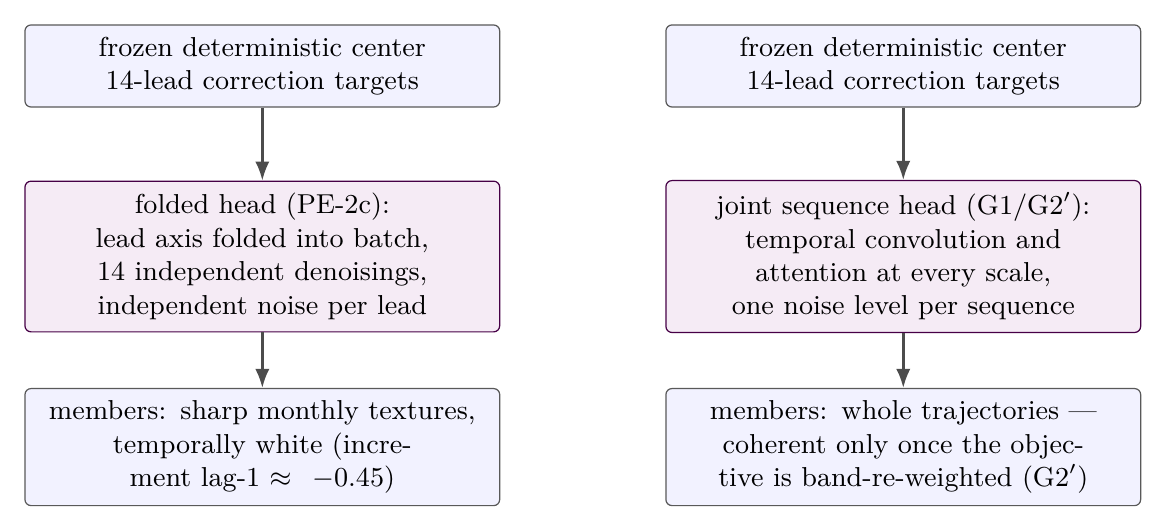
Report 6's PE-2c diffusion head folds the lead axis into the batch axis: each of the 14 monthly corrections is denoised independently, with independent noise, conditioned only on that month's mean correction field (uncertainty.py::denoising_loss). Two consequences, both confirmed: members are not trajectories (temporally independent textures, visible as month-to-month jitter in member Hovmöllers), and the spread carries no flow dependence (Report 7: corr($\lvert$error$\rvert$, spread) $0.05$–$0.16$). Phase F proved the missing conditional-variance information is learnable from CMIP; Phase G moves temporal structure and state-awareness into the generator. Four questions separate the causal factors: does imposed continuity suffice (G0); does temporal architecture capacity suffice (G1); does the objective supply the needed gradient pressure (G2$'$); and does the learned head, once coherent, calibrate (G3$'$, G2-long)? Figure 6 summarizes the resulting ladder on the trajectory metrics.
3. Focused Literature Review
The relevant evidence comes from probabilistic weather forecasting, video diffusion, and spatiotemporal downscaling. Two lessons recur. First, temporal coherence is created by architecture and conditioning, not post-hoc noise fixes: CorrDiff-style residual diffusion restores fine spatial detail but does not guarantee time coherence [1], while methods that model time either add a lead/trajectory axis or make the model continuous in time [2]. Second, correlated noise is a control, not a cure: continuous ensemble forecasting shows correlated driving noise mainly changes trajectory autocorrelation while leaving per-lead skill governed by the underlying model [2], and ERDM treats temporally correlated noise as orthogonal to the forecasting architecture. For the joint head itself, video-diffusion practice factorizes space and time rather than collapsing time into channels [3, 4], and EDM-style formulations [5] underlie the strongest weather diffusion systems [6]. On scoring, the variogram score is preferred over the energy score as the primary multivariate temporal score because it is more sensitive to mis-specified dependence [7]. We test architecture and objective as separate causal factors — a discipline the ledger enforces and the results reward.
4. Temporal Metrics and Gates
Beyond the carried D1–D6, P1–P3, P4a/P4b, P5a/P5b, and P6, this report adds the trajectory extension T1–T5 (series charter): the temporal-difference ratio T1 (target $[0.8,1.2]$), increment autocorrelation T2 (versus observed $+0.161$ lag-1), the variogram and energy scores T3, the high-frequency power fraction T4, and the center-specific flow-dependence diagnostics T5a (learned center, canonical) and T5b (frozen-PB-1-error, historical). Carried gates: frozen-mean identity, member sharpness, per-band energy, spread–skill $[0.8,1.2]$, coverage $\pm10$ points, fair CRPS $\le$ raw, and the aspirational flow-dependence $>0.3$; lifecycle metrics are gated on held-out CMIP only (the observed slice holds essentially one event ramp).
4.1 CRPS Estimator Audit Boundary
Canonical P1 is fair CRPS evaluated per window/lead over the member axis. The shared Phase F/G projection scorer instead reshaped $[\mathrm{window},\mathrm{member},\mathrm{lead}]$ directly, mixing leads and members; its recorded CRPS values are historical decision evidence, not canonical P1. This report carries verified corrected values only for the final G2-long validation and E4b artifacts; every earlier rung's CRPS is the archived value, labeled as such, pending recomputation.
4.2 Common Forecast Coordinates
$24\times48$ tropical Pacific; 12/14-month geometry; train 1981–2010; validation 2011–2015 (35 windows). Phase G development had no test access; only after adoption did the written amendment authorize one E4b read. Cosine-weighted Niño-3.4 box, leads-3–14 calibration scope; persistence and zero-anomaly baselines; the canonical 32-member ensemble with recorded seed, $\eta$, $\rho$, and sampler steps.
The independent per-month DDIM noise — both the initial latent and the $\eta{=}1$ per-step noise — is replaced by a stationary AR(1) process across lead with unit marginal variance,
a sampling knob on PE-2c (no retraining). Sweeping $\rho\in\{0, 0.607, 0.779, 0.882, 1.0\}$ paired by window seed: index T1 moves $1.279$ (too jittery) $\to0.977$ (near-perfect at $\tau_2$, $\rho{=}0.607$) $\to0.168$ (frozen, at common noise); the $\tau_2$ guards pass (spread–skill $0.399$; archived CRPS $+0.4\%$). But flow dependence at the operating point moves only $+0.080$ vs control ($<$ the predeclared $0.10$ threshold); it reaches $+0.255$ only at common noise, which collapses the ensemble (T1 $0.168$, guards fail). No $\rho$ delivers real flow dependence without destroying the ensemble — a textbook confirmation that the architectural time axis is required, not a noise prior. A structural limit also appears: observed increments are positively autocorrelated ($+0.161$: ENSO has momentum), and AR(1) noise around a frozen mean can only reduce the differencing-induced negative autocorrelation, reaching $+0.161$ only by overshooting to common noise ($+0.568$). $\tau_2$ is selected as the presentation sampler and G1 baseline; nothing is adopted as a skill claim.
6. G1: Joint Sequence Architecture
The new head (replacing the folded denoiser; Fig. 1) is a 1.80M-parameter 2-D residual U-Net over $24\times48$ (scales $24{\times}48\to12{\times}24\to6{\times}12\to 3{\times}6$) with a depthwise temporal convolution ($k{=}3$) at every scale and temporal self-attention with relative-lead bias at the two coarsest scales, adaptive-norm diffusion-time embedding, and an explicit lead embedding in every block. It denoises the whole $[B,14,37,24,48]$ correction sequence at one per-sequence noise level. The formulation is identical to PE-2c ($\varepsilon$-prediction, cosine schedule, 50-step DDIM $\eta{=}1$, $x_0$ clamp 4.0), so G1 isolates the time-axis and full-trajectory-conditioning effect. Conditioning v1 (free): the full 14-month mean trajectory via temporal mixing, lead embedding, target-month encoding, and a compact context state. Training: 8,000-step CMIP pretrain (held-out selection) $\to$ 1,000-step observed head-only fine-tune.
6.1 Architectural Negative
The head fits the correction distribution as well as the folded head (held-out denoising $0.401$, observed $0.394$, both $\approx$ PE-2c's $0.40$) and learns no temporal coherence. Across the $\eta$ sweep: member T1 $1.305$–$1.765$ (worse than the folded $1.279$ — more jittery); lag-1 increment autocorrelation stuck at $-0.45$ at every $\eta$ (the MA(1)$\approx-0.5$ signature of temporally independent textures), never approaching observed $+0.161$; flow dependence sign-flipping around zero ($+0.08/-0.28/+0.05/-0.08$). The sweep refutes the hypothesis that $\eta{=}1$ was masking learned coherence: even at $\eta{=}0$ (the setting most favorable to it), members are temporally independent. $\eta$ is a spread$\leftrightarrow$jitter knob (raising it lifts both spread–skill $0.369\to0.521$ and jitter), not a coherence knob. The one real gain is spread–skill; the mean-bypass RMSE ($0.067\,{}^{\circ}\mathrm{C}$) exceeds its gate. Diagnosis: per-cell denoising MSE supplies temporal capacity but no temporal pressure — the temporal analogue of Phase E.
7. Correction-Structure Audit
A predeclared measurement resolves the G1 negative precisely (Fig. 2). Decomposing the true corrections (truth minus frozen PB-1) and G1's sampled corrections ($\eta{=}0$) by band:
| band | true corr. lag-1 | G1 sampled lag-1 | share of denoising-MSE weight |
|---|---|---|---|
| lowpass | 0.645 | 0.019 | 1.1% |
| level 3 | 0.487 | $-0.077$ | 2.3% |
| level 2 | 0.377 | 0.013 | 12.1% |
| level 1 (finest) | 0.267 | 0.034 | 84.4% |
The true index-error trajectory is extremely persistent (level lag-1 $+0.816$; increment lag-1 $+0.190\approx$ observed). Three facts convict the objective: (i) the true corrections carry rich temporal structure in every band, strongest where the index lives; (ii) per-channel normalization makes every lifted cell equal weight, and the finest band owns $\sim84\%$ of the valid cells, so the objective spends $\sim84\%$ of its gradient on the band with the least temporal structure and (per F0) $0.1\%$ of index-error variance, while the index-carrying lowpass gets $\sim1\%$; (iii) G1's samples captured essentially none of the structure in any band. This also retroactively illuminates Phase E: the fine-scale over-cook and the calibration wall's indifference to $64\times$ data are what an objective dominated by unpredictable fine-band texture looks like.
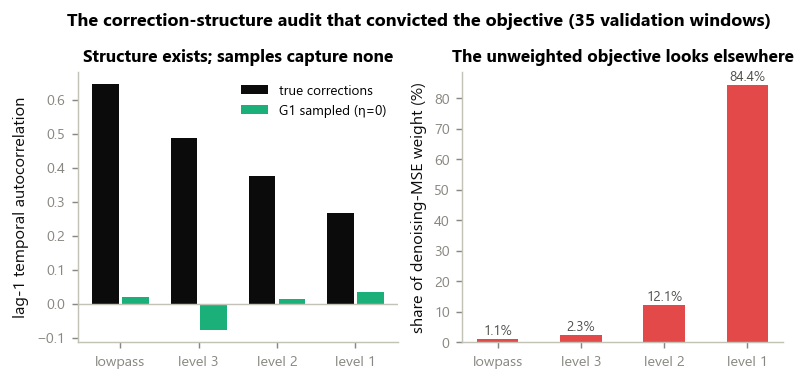
E3-VAL, 35 windows). Left: true corrections are temporally correlated in every band; G1 samples are temporally white everywhere. Right: the unweighted per-cell objective spends $84.4\%$ of its gradient on the finest, least-structured band.AR(1) sampling (1) on the trained G1 checkpoint gives the best variogram measured to date (1.503 at $\tau_2$) and higher spread–skill (0.532), but a $\sim14\%$ CRPS regression under the archived scorer ($0.2808$ vs G0 $\tau_2$'s $0.2463$). By the predeclared CRPS-priority rule, G0 $\tau_2$ is retained as the presentation product; the trajectory diagnostics rule out simply stacking imposed noise correlation on G1 as the main solution. (Magnitudes await canonical rescoring; the split verdict does not.)
9. G2$'$: Equal-Band Denoising Objective
Changing only the wavelet-band weights — architecture, data, steps, and sampler held fixed — from cell-count weighting to equal-band (each band the same total weight, mean-normalized over valid cells),
passes the structure gate causally: sampled lowpass lag-1 autocorrelation $0.019\to\mathbf{0.308}$ ($\ge0.3$; true $0.645$) from the objective change alone. Further wins: the best point forecast in the project (ensemble-mean Niño-3.4 RMSE $0.4827$ vs PE-2c-ensemble $0.4916$ vs PB-1 $0.5256$ — the $0.339\,{}^{\circ}\mathrm{C}$ ensemble-mean shift is learned predictable lowpass error signal, not harmful bias, so the mean-bypass gate “failure” is recorded as inapplicable in this regime), and the best fair CRPS in the project at $\eta{=}0.5$ ($0.2435 <$ G0 $\tau_2$'s $0.2463$, archived, pending recomputation). Remaining deficits are one phenomenon — insufficient stochastic variation around a now-smooth conditional mean: T1 $0.67$–$0.74$ (over-smooth), spread–skill $0.25$–$0.32$, coverage $22/35/42\%$, variogram $1.93$. Only the lowpass crossed the learning threshold (fine bands still $\approx0$); and the 8k CMIP pretrain was still improving, an unexploited lever.
10. G3$'$: Calibration Center Experiment
Applying the Phase F machinery (flat F1a and conditional F3) to the G2$'$ $\eta{=}0.5$ ensemble in two centering variants isolates the role of the mean: G3$'$-A recenters on frozen PB-1 (the exact F-phase protocol); G3$'$-B recenters on G2$'$'s own better ensemble mean.
| variant | mean RMSE | P2 | P3 50/80/90 | fair CRPS$^{\ast}$ | vs raw |
|---|---|---|---|---|---|
| G2$'$ raw ($\eta{=}0.5$) | 0.489 | 0.313 | — | 0.2472 | — |
| G3$'$-A F3 (PB-1 center) | 0.526 | 1.089 | 60/83/90 | 0.2739 | $+0.027$ |
| G3$'$-B F1a-flat (ens. center) | 0.489 | 0.972 | 59/76/82 | 0.2496 | $\mathbf{+0.0024}$ |
| G3$'$-B F3-cond (ens. center) | 0.489 | 1.258 | 68/88/92 | 0.2558 | $+0.009$ |
E3-VAL, LOYO; only the recentering target differs between A and B). $^{\ast}$archived scorer, pending canonical recomputation.The decisive contrast is A vs B, which differ only in the recentering target: recenter on PB-1 and flat calibration reproduces the familiar $+11\%$ CRPS wall; recenter on G2$'$'s own better mean and it becomes CRPS-neutral ($+1\%$) while reaching spread–skill $0.972$ and near-nominal coverage. This cleanly proves the hypothesis: G2$'$'s learned mean was the CRPS bottleneck — fix the mean and flat calibration fixes reliability without paying CRPS. The conditional variant over-disperses ($1.258$) because the CMIP $\sigma$ is scaled to PB-1-magnitude errors and the LOYO per-fold scales ($0.97/1.04/0.91$) do not shrink enough for G2$'$'s smaller errors — but it delivers the best flow dependence in the project ($0.223$, up from $0.160$).
11. G3$''$ and F1b
A partial-conditioning blend (compressing the conditional $\sigma$'s window-variation toward its per-lead geometric mean, then applying the conditional per-fold scale) was built to convert the $0.223$ flow dependence into an in-range spread. The finding is a rigorous negative bounded by the data: flow dependence never exceeds $0.223$ at any blend strength, so the $>0.3$ gate is unreachable on this three-year slice — the named F3 ceiling (the 2013 neutral-onset windows) is a property of the slice, and corr($\lvert$G2$'$ error$\rvert$, $\sigma$) $=0.298\approx$ PB-1's $0.318$ confirms the better mean did not invert the state-dependence. (An honest implementation note: a first blend design gave the held-out event fold the smallest spread and negative flow dependence; the bug was found and fixed during the run, and the corrected tool reproduces the full conditional at strength 1, unit-tested.) G3$'$-B F1a-flat remains the best index product. Coherent lowpass F1b lifting (Report 7) — lifting the zero-member-mean deviation difference through a lowpass, unit-Niño-3.4-average pattern $B_\ell$,
— then materializes the calibrated spread in fields: exact index fidelity, invariant mean, highpass changes $2.0/0.5/1.1\%$, member std $0.587\to0.822$ (into the sharpness band).
12. G2-long: Pretraining-Length Ablation
Changing only the CMIP pretraining from 8,000 to 16,000 steps (Fig. 3) is the single biggest Phase G improvement, confirming the 8k base had not converged:
| metric | G2$'$ (8k) | G2-long (16k) |
|---|---|---|
| pretrain held-out weighted loss | 0.477 | 0.402 |
| observed validation loss | 0.394 | 0.381 |
| sampled lowpass lag-1 (true 0.645) | 0.308 | 0.392 |
| best raw fair CRPS (at $\eta$)$^{\ast}$ | 0.247 (0.5) | 0.2405 (1.0) |
| ensemble-mean Niño-3.4 RMSE (PB-1 $=0.5256$) | 0.489 | 0.4748 |
raw flow dependence T5a | $-0.08$ | $+0.152$ |
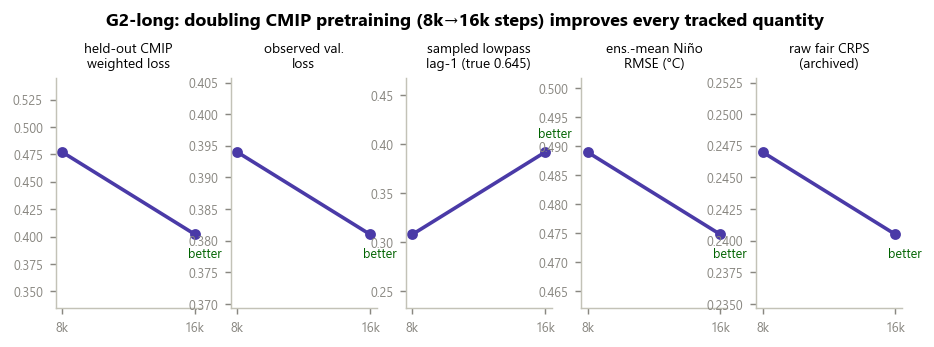
E2-SIM $\to$ E3-VAL) improves every tracked quantity: more temporal structure across all bands, a better mean, lower CRPS, and the first positive raw flow dependence. The optimal sampler shifts from $\eta{=}0.5$ to $\eta{=}1.0$.More pretraining learned more temporal structure across all bands (fine-band lag-1 $0.049/0.061/0.065$ vs $\approx0.01$–$0.03$), a better mean, and the first positive raw flow dependence. Metric-provenance note: the raw canonical T5a on the final seed-42 artifact is $+0.354$; the separately reported $+0.152$ is the historical sequence diagnostic T5b (frozen PB-1 error, different per-window seeds) and is not T5a for the learned-center product. Archived raw fair CRPS $0.2405$; canonical audit $0.2396$.
13. Final Adopted Validation-Basis Product
The adopted stack: G2-long sequence diffusion checkpoint (CMIP pretrain e2dde94a…, 16k steps, equal-band; 1,000 observed head-only steps around frozen PB-1 c6b49723… on v3 backbone 2247c1f9…), sampled at $\eta{=}1$, $\rho{=}0$; flat LOYO EMOS/ECC-Q recentered on the learned ensemble mean; coherent lowpass F1b lifting. Calibrated metrics: spread–skill $0.958$, coverage $59/77/82\%$, fair CRPS $0.2396\to0.2463$ (canonical audit; archived $0.2405\to0.2500$), exact index fidelity, mean-field shift $\approx2.4\times10^{-7}\,{}^{\circ}\mathrm{C}$, highpass changes (P5b) $2.3/0.5/1.0\%$, and field-lifting ratio (P4b) $0.608\to0.800$. Flat inflation flattens canonical T5a from $+0.354$ raw to $-0.492$ calibrated — the reliability$\leftrightarrow$flow-dependence tension; $b>0$ raw-spread blending was swept and does not help. P4b/P5b are not compared with PE-style P4a/P5a.
13.1 Adoption, Waiver, and Evidence Boundary
Per the latest append-only ledger, user direction formally adopted the stack on 2026-07-12 despite missing the strict CRPS-not-worse-than-raw gate under both the archived scorer ($+0.0095$) and the corrected audit ($+0.0067$) — a Monte-Carlo-noise margin, but a miss, waived exactly as budgets were earlier waived. Disclosed with the adoption: flat inflation changes canonical T5a from $+0.354$ raw to $-0.492$ calibrated; validation was adaptively reused; 2016–2020 was already known project-wide from PB-1; and adoption preceded all G2-long test access.
14. Final-Protocol Amendment and Pre-Read Expectation
A written amendment — exercising the bounded provision predeclared in the Phase E plan (“if and only if a generative head is adopted on validation, one additional single-shot test of that one model plus PB-1 and the two baselines”) — authorized exactly one report-only evaluation of the checkpoint SHA-256 16a865bc… fc381c1. Frozen: $\eta{=}1$, $\rho{=}0$, 32 members, seed 42, the learned ensemble center, and the flat $\sigma(\ell)$ fit on all 2011–2015 windows and applied unchanged to test. The recorded pre-read expectation was a modest point-skill improvement and reasonable reliability. E4b is genuine held-out but lower-weight, reported-not-gated evidence: G2-long never saw a test month during development (verifiable), but far more researcher degrees of freedom were exercised on validation than for PB-1. Declared scope: raw G2-long fields/center and calibrated Niño-3.4 trajectories only; F1b lifted fields and T1–T5 were not tested.
15. Second and Final Sealed-Test Result (E4b-TEST)
15.1 Pipeline Sanity and Deterministic Ensemble Center
The frozen mean_head first reproduces PB-1's sealed-test numbers to the reported digit (RMSE 0.5406, ACC $+0.2553$, Niño-3.4 correlation $+0.3432$, 35/35), confirming identical test data and pipeline. For the sampled ensemble center (Table 2, Fig. 4):
| Metric (2016–2020, 35 windows) | G2-long ens. mean | PB-1 (frozen) | baseline |
|---|---|---|---|
| pooled field RMSE (${}^{\circ}\mathrm{C}$) | 0.5390 | 0.5406 | pers. 0.6591 |
| windows beating persistence | 34 / 35 (97.1%) | 35/35 | — |
| mean field ACC | $+0.2229$ | $\mathbf{+0.2553}$ | pers. $+0.2292$ |
| Niño-3.4 corr. leads 3–14 | $\mathbf{+0.3532}$ | $+0.3432$ | pers. $-0.015$ |
| Niño-3.4 RMSE leads 3–14 (${}^{\circ}\mathrm{C}$) | 0.6912 | 0.5714 | zero 0.5821; pers. 0.7774 |
E4b-TEST). G2-long ties PB-1 on field RMSE, is marginally better on Niño-3.4 phase correlation, and worse on field ACC and Niño-3.4 amplitude error — worse than both PB-1 and zero anomaly on the index.The result splits at the index level: all 14 full-field leads beat zero, but G2-long beats zero on only 5/14 Niño-3.4-RMSE leads. The headline paired interval (center minus persistence, Niño-3.4 RMSE, block 6, 10,000 resamples, seed 20260703) is $-0.086$, 90% CI $[-0.432,+0.090]$: unresolved (35 event-dominated windows give a wide index CI; the field-RMSE win at 97% of windows is the stronger persistence comparison). No paired interval versus PB-1 was computed, so the point estimates are called mixed — not statistically equivalent or improved. Amplitude stays damped (std ratio $0.40$).
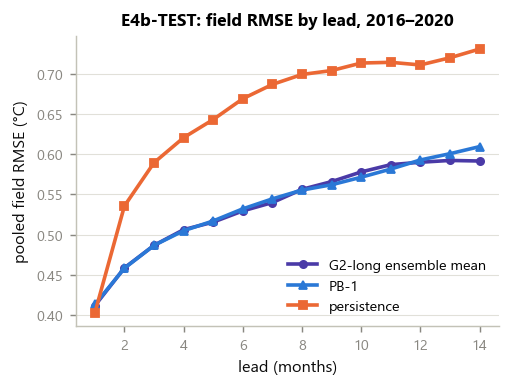
TR1): the validation-period Niño-3.4-RMSE advantage over PB-1 ($+0.0508\,{}^{\circ}\mathrm{C}$) becomes a $-0.1198\,{}^{\circ}\mathrm{C}$ deficit on test (contrast $-0.1706\,{}^{\circ}\mathrm{C}$).15.2 Held-Out Calibration and Metric Audit
Applying the validation-fit flat $\sigma$ unchanged: raw-to-calibrated spread–skill $0.263\to0.641$; coverage $20/38/45\% \to 43/61/68\%$ (Fig. 5). Canonical per-window/per-lead fair CRPS $0.4369\to0.3890$; the archived axis-mixed pair $0.4450\to0.4107$ is a provenance note only. The qualitative conclusion — calibration improves CRPS but the ensemble remains under-dispersed because 2016–2020 errors exceed the 2011–2015 scale $\sigma$ was tuned on — is unchanged between scorers. Raw member sharpness (P4a) is $0.579/0.552/0.463$ (full/equatorial/Niño-3.4), below the prior sharpness gates, and reported as such rather than as an unqualified “sharp” claim.
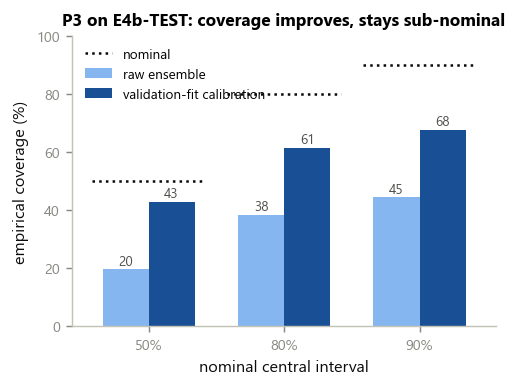
P3), raw and under validation-fit calibration; dotted rules mark nominal. Calibration improves every interval but none reaches nominal — partial transfer.15.3 Validation-to-Test Transport and Final Status
The reversal is explicit (TR1, Fig. 4): G2-long's Niño-3.4-RMSE advantage over PB-1 moves from $+0.0508\,{}^{\circ}\mathrm{C}$ on validation to $-0.1198\,{}^{\circ}\mathrm{C}$ on test, a transport contrast of $-0.1706\,{}^{\circ}\mathrm{C}$ under a convention where positive favors G2-long. The near-nominal validation calibration (TR2) becomes only partial on test. This second and final read fully spends 2016–2020; later calculations from the frozen records are audit-only and cannot create new confirmatory evidence.
16. Persistent Series Scorecard
Raw and calibrated D1–D6; P1–P3, P4a/P4b, P5a/P5b, P6; and T1–T4 plus T5a/T5b for PE-2c, G0, G1, G2$'$, and G2-long under one canonical artifact (validation values above). A separate E4b block covers only the tested D and P metrics (Tables 2, and the raw/calibrated $0.263/0.641$ P2, $20/38/45\to43/61/68$ P3, $0.4369\to0.3890$ P1); F1b P4b/P5b and all T metrics stay at E3. TR1 $=-0.1706\,{}^{\circ}\mathrm{C}$; TR2 the raw-to-calibrated reliability changes above. X4: adopted checkpoint 16a865bc…; CMIP pretrain e2dde94a… (16k); frozen mean c6b49723…; v3 backbone 2247c1f9…; sampler $\eta{=}1$, $\rho{=}0$, 32 members, seed 42; authorizing amendment and materialization audit establish E4b status (a stale “validation-only” status string in the probabilistic summary despite split=test is superseded by the amendment and audit). Every value labels CRPS estimator version, lead scope, center identity, seed, $\eta$, $\rho$, member count, post-processing, and calibration fit/evaluation mode; lifecycle metrics on held-out CMIP are kept separate from descriptive observed cases.
17. Discussion
Mechanism. Architecture supplies capacity; equal-band weighting supplies coarse-scale gradient pressure; longer simulation training consolidates temporal structure and mean skill. The G1/G2$'$ single-variable contrast is an unusually clean demonstration that a sequence model can fit the marginal denoising task perfectly while learning none of the temporal structure the loss does not reward, and that re-weighting the same objective across scales causally unlocks it.
The reliability–flow-dependence tension and its sensitivity. The raw canonical T5a is positive ($+0.354$), but flat calibration makes it negative ($-0.492$) while improving average spread reliability — inflation that fixes the mean level of the spread flattens its state variation. The magnitude is center- and seed-sensitive (the historical $+0.152$ used a different diagnostic on different seeds), which is itself part of the report's caution.
The E3-to-E4b reversal. A mean advantage and near-nominal calibration developed under heavy adaptive reuse of 35 overlapping windows dominated by one event cycle reverted on 35 held-out windows with different events. The robust result is field RMSE at PB-1; the validation-specific results are the regional-mean and calibration advantages. The held-out evidence is mixed — neither equivalence nor superiority — which is what a single honest sealed read of a heavily consulted product should be expected to deliver.
18. Limitations and Required Future Evidence
Adaptive validation reuse and waived budgets through Phases E–G; only three LOYO folds; seed sensitivity (one fixed 32-member realization per artifact); no strict-gate pass before the adoption waiver; one lower-weight probabilistic E4b read; simple flat calibration; a residual increment-autocorrelation gap (members never reach observed $+0.161$); and no operational ONI/Brier verification. The archived CRPS axis-order defect touched every earlier Phase F/G gate record; canonical rescoring is complete for the final G2-long artifacts, pending for earlier rungs. Thin posthoc provenance; no test of F1b/T1–T5; and no G2-long-versus-PB-1 equivalence interval. A new independent period/product or a prospective evaluation is required; the protocol-spent 2016–2020 split cannot support another held-out claim. The runtime gate verifies the declared checkpoint/document but maintains no global one-shot counter — finality rests on the amendment and the append-only ledger.
19. Conclusion
The temporal-head arc reached a real destination: a coherent probabilistic research product and a causal explanation for the temporal-objective breakthrough (a temporal architecture supplies capacity, but the per-cell objective must be re-weighted to give the coarse bands gradient pressure — and that single change unlocked learned coherence and a better mean, which in turn made post-hoc calibration CRPS-competitive for the first time; longer pretraining compounds it). The final claim is scoped exactly: the system was adopted for project use on validation evidence, and its later E4b result showed mixed point estimates plus partially calibrated uncertainty rather than a resolvable improvement over PB-1; raw physical members remained below the declared P4a amplitude thresholds. PB-1's first pristine E4a-TEST result stands as the project's strongest confirmatory evidence, and the shared test period is fully spent.
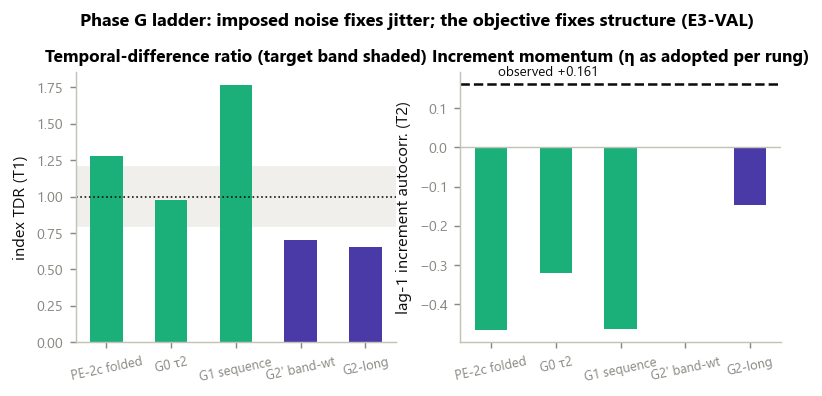
E3-VAL). Imposed noise (G0) fixes T1 without touching increment momentum; the sequence architecture alone (G1) worsens jitter; the band-weighted objective (G2$'$/G2-long) is the only rung that moves T2 toward observed while approaching the T1 band.References
- M. Mardani et al., “Residual corrective diffusion modeling for km-scale atmospheric downscaling,” arXiv:2309.15214, 2023.
- M. Andrae, T. Land\-elius, J. Oskarsson, and F. Lindsten, “Continuous ensemble weather forecasting with diffusion models,” arXiv:2410.05431, 2024.
- J. Ho, T. Salimans, A. Gritsenko, W. Chan, M. Norouzi, and D. J. Fleet, “Video diffusion models,” in Advances in Neural Information Processing Systems, vol. 35, 2022.
- A. Blattmann et al., “Stable Video Diffusion: Scaling latent video diffusion models to large datasets,” arXiv:2311.15127, 2023.
- T. Karras, M. Aittala, T. Aila, and S. Laine, “Elucidating the design space of diffusion-based generative models,” in Advances in Neural Information Processing Systems, vol. 35, 2022.
- I. Price et al., “Probabilistic weather forecasting with machine learning,” Nature, 637:84–90, 2025.
- M. Scheuerer and T. M. Hamill, “Variogram-based proper scoring rules for probabilistic forecasts of multivariate quantities,” Monthly Weather Review, 143:1321–1334, 2015.